
Researchers have found a possible way to stop abnormal signals in the retina that are linked to involuntary eye movements (nystagmus). In experiments on mouse retinas in the lab, restoring dopamine signaling stopped these abnormal signals and reduced the “noise” that interferes with visual signals—offering a potential dual benefit of quieting the abnormal eye movements while also increasing visual acuity. The next step is to find out whether the approach also works in living animals.
Nystagmus causes involuntary, repetitive eye movements and can reduce vision. It is often seen in people with congenital stationary night blindness (CSNB), an inherited form of night blindness. There is currently no cure for the condition.
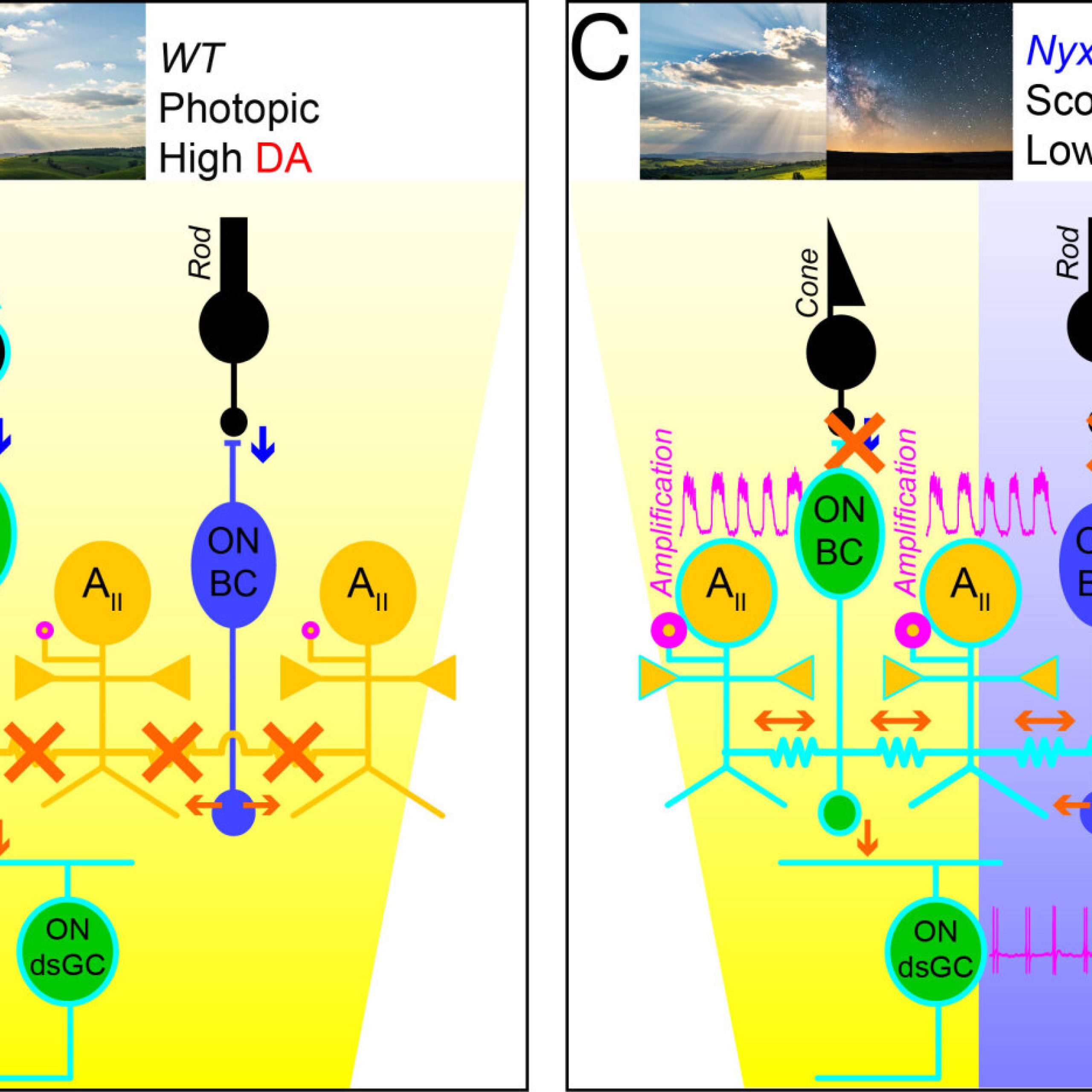
Nystagmus has traditionally been thought to originate in the brain, in the circuits that control eye movements. But previous research by the team showed that, in this form of night blindness, the problem starts in the retina—the light-sensitive layer at the back of the eye. Cells in the retina produce abnormal rhythmic electrical signals, which are then passed on to the brain and trigger the involuntary eye movements.
In the new study, the researchers investigated why these abnormal signals occur. They focused on dopamine, a chemical messenger that helps the retina adapt to light and darkness. In this form of night blindness, dopamine release in the retina is reduced.
Using retinas taken from a mouse model of night blindness, the researchers found that restoring dopamine signaling stopped the abnormal electrical activity. It also strengthened the retina’s response to light and made the visual signal from the retina less “noisy.” The unwanted electrical activity acts as a kind of background “noise,” making it harder for the retina to pass on visual information. Reducing this noise improved the quality of the signal.
From discovery to possible treatment
The findings are still an early step toward a possible treatment. So far, the approach has been tested on isolated mouse retinas, not in living animals. B. Semihcan (Semih) Sermet (first author of the study) explains: “The next step is to test whether it also works in living animals. One possibility would be to deliver a drug targeting the dopamine system through eye drops.”
If that works, the approach could eventually offer a way to reduce nystagmus and improve visual performance. It would not cure the underlying night blindness itself, and much more research is needed before the approach could be considered for patients.
The findings also have implications beyond night blindness and other disorders associated with nystagmus, extending to conditions such as retinitis pigmentosa, where the retina is also known to generate aberrant electrical activity. Sermet notes “In retinitis pigmentosa, this background noise interferes with retinal implants designed to restore vision in patients. Restoring dopamine signaling to quiet this noise and sharpen the signal could facilitate this process and help retinal implants work more effectively.”
Why fundamental research matters
For Sermet, the study also shows why fundamental research is important. “We did not start with a potential treatment. The discovery grew out of 20 years of detailed research into how the retina works and how its cells communicate, which was led by professor Maarten Kamermans, who sadly passed away recently. It is important to realize how key fundamental research is,” Sermet says.
He describes this basic knowledge as the “building blocks” needed to understand what goes wrong in disease. By uncovering how the retina works, the researchers were able to trace the abnormal signals to their source and find a possible way to stop them.
Publication details
B. Semihcan Sermet et al, Dopamine suppresses pathological retinal oscillations and enhances the signal-to-noise ratio, Proceedings of the National Academy of Sciences (2026). DOI: 10.1073/pnas.2535572123
Journal information:
Proceedings of the National Academy of Sciences
Key medical concepts
Clinical categories


Citation:
Involuntary eye movements could be targeted by restoring retinal dopamine, mouse experiments suggest (2026, October 8)
retrieved 15 October 2026
from https://medicalxpress.com/news/2026-10-involuntary-eye-movements-retinal-dopamine.html
This document is subject to copyright. Apart from any fair dealing for the purpose of private study or research, no
part may be reproduced without the written permission. The content is provided for information purposes only.