
When you go for a walk, how does your brain know the difference between a parked car and a moving car? This seemingly simple distinction is challenging because eye movements, such as the ones we make when watching a car pass by, make even stationary objects move across the retina—motion that has long been thought of as visual “noise” the brain must subtract out.
Source link
Eye movements help the brain see in 3D: Research challenges long-standing assumption
February 7, 2026
0 Comments
Explore More
Eye drops derived from PEDF protein slow vision loss in animal models

Model of PEDF protein alongside the 17-mer and H105A peptides. Amino acid 105, which is changed from histidine in PEDF and the 17-mer peptide to alanine in the H105A peptide,
Eye movements predict speed limits in perception

Much like chipmunks dart around in rapid bursts, our eyes swiftly dart from one place to the next. These eye movements create high-speed motion that increases with the distance they
Eye cells ‘rewire’ themselves when vision begins to fail, study finds
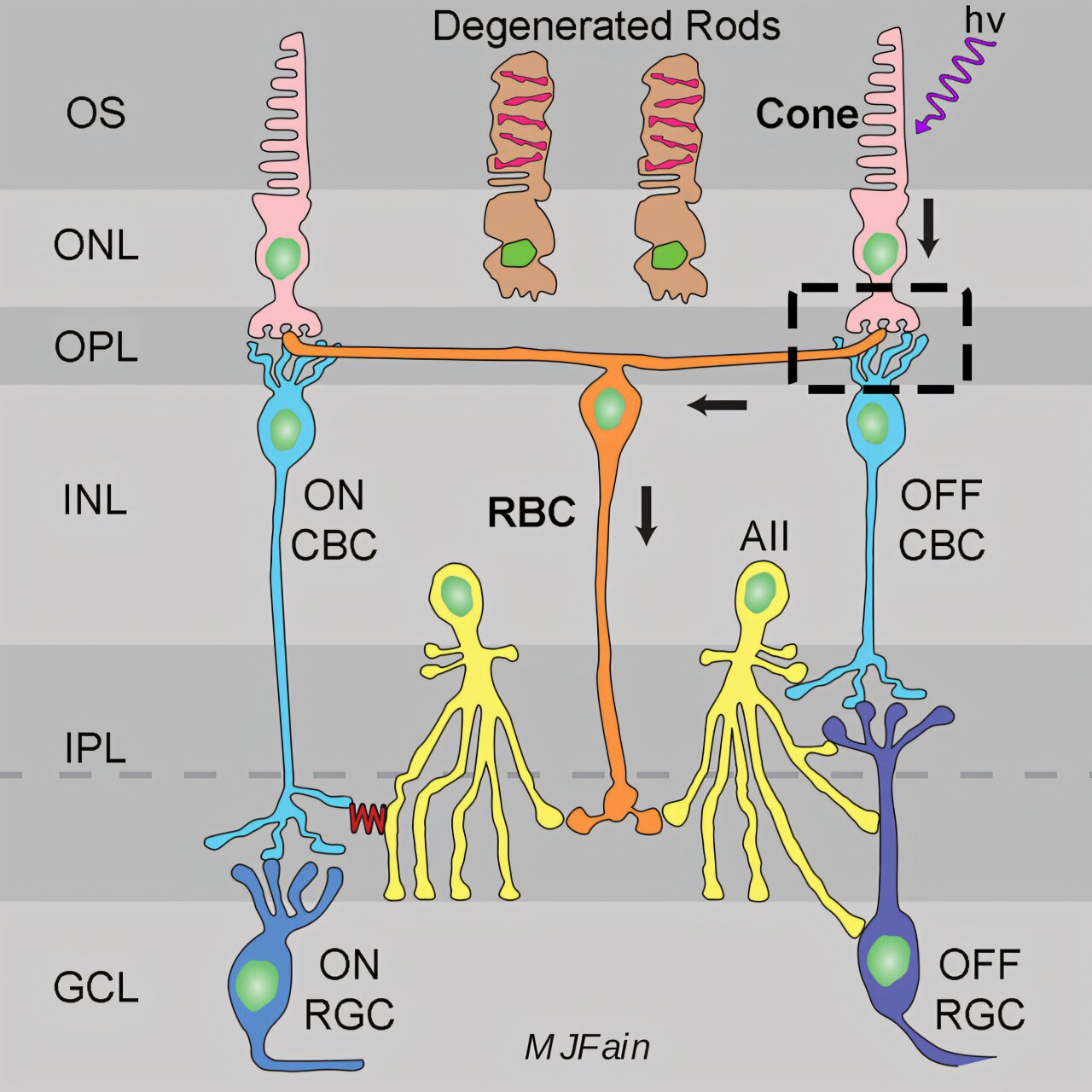
Graphical abstract. Credit: Current Biology (2025). DOI: 10.1016/j.cub.2025.05.057 Scientists at the Jules Stein Eye Institute at the David Geffen School of Medicine at UCLA have discovered that certain retinal cells