
Scientists at the Jules Stein Eye Institute at the David Geffen School of Medicine at UCLA have discovered that certain retinal cells can rewire themselves when vision begins to deteriorate in retinitis pigmentosa, a genetic eye disease that leads to progressive blindness.
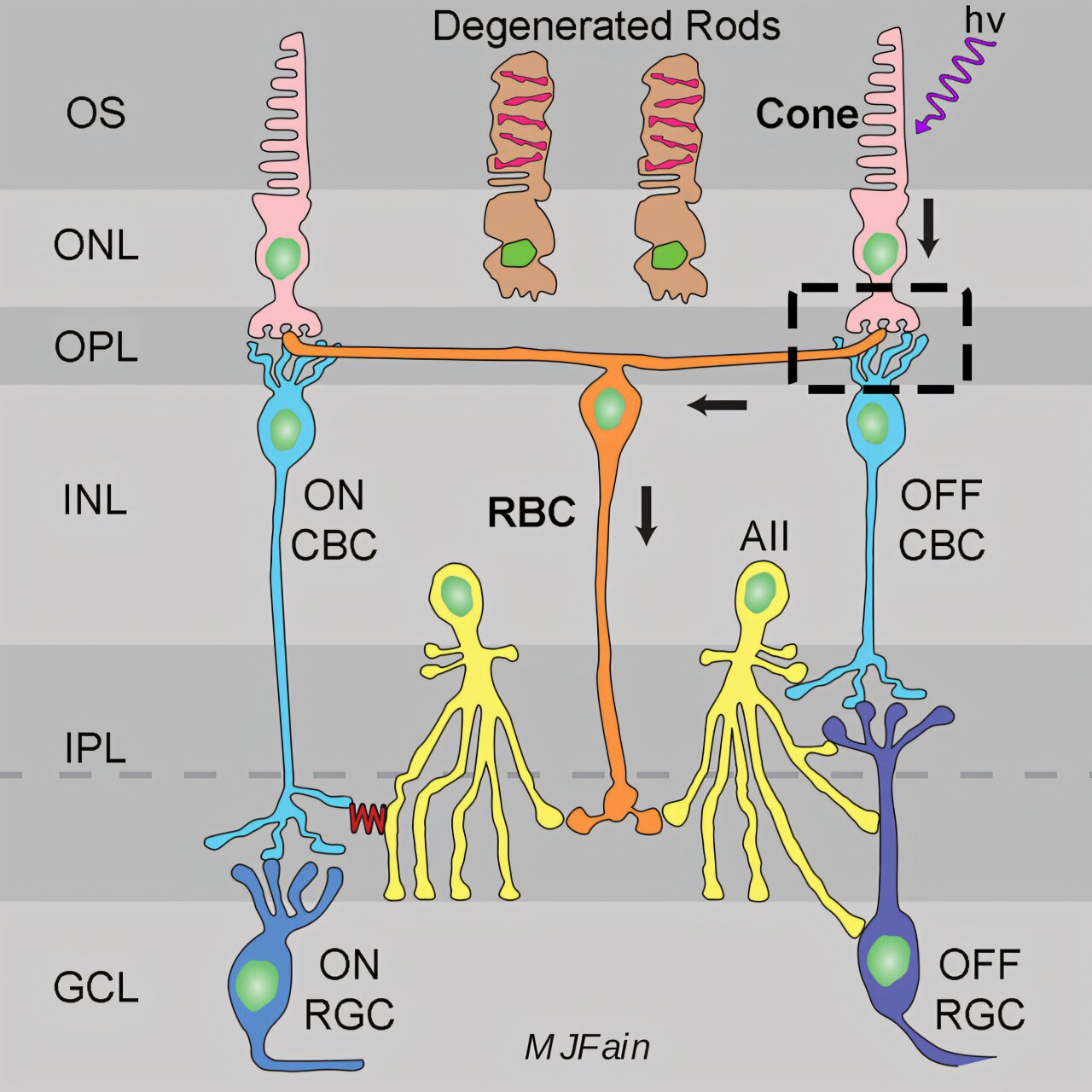
In a study using mouse models, researchers found that rod bipolar cells, neurons that normally receive signals from rods that provide night vision, can form new functional connections with cones that provide daytime vision when their usual partners stop working. The study appears in Current Biology.
Retinitis pigmentosa affects millions of people worldwide and is a leading cause of inherited blindness. While the disease often progresses slowly, with some patients maintaining a surprising amount of usable vision into middle age, little is known about how retinal circuits adapt to cell loss. Understanding these natural adaptation mechanisms could reveal new targets for treatments aimed at preserving vision.
Researchers used rhodopsin knockout mice that model early retinitis pigmentosa, where rod cells cannot respond to light and degeneration proceeds slowly. They made electrical recordings from individual rod bipolar cells, neurons that normally connect to rods, to see how these cells behaved when their usual input was lost.
The team also used additional mouse models lacking different components of rod signaling to determine what triggers the rewiring process. They supported their single-cell findings with whole-retina electrical measurements.
Rod bipolar cells in mice lacking functional rods showed large-amplitude responses driven by cone cells instead of their normal rod inputs. These rewired responses were strong and had the expected electrical characteristics of cone-driven signals.
The rewiring occurred specifically in mice with rod degeneration, but not in other mouse models that lacked rod light responses without actual cell death. This suggests that the cellular rewiring is triggered by the degeneration process itself, rather than simply the absence of light responses or broken synapses.
The findings complement the research team’s previous 2023 work showing that individual cone cells can remain functional even after severe structural changes in later disease stages. Together, these studies reveal that retinal circuits maintain function through different adaptation mechanisms at various stages of disease progression.
The research shows that retinal adaptation occurs through different mechanisms at various disease stages, which could help scientists identify new targets for preserving vision in patients with inherited retinal diseases.
“Our findings show that the retina adapts to the loss of rods in ways that attempt to preserve daytime light sensitivity in the retina,” said senior author A.P. Sampath, Ph.D. of the Jules Stein Eye Institute at the David Geffen School of Medicine at UCLA.
“When the usual connections between rod bipolar cells and rods are lost, these cells can rewire themselves to receive signals from cones instead. The signal for this plasticity appears to be degeneration itself, perhaps through the role of glial support cells or factors released by dying cells.”
One of the open questions is whether this rewiring represents a general mechanism used by the retina when rods die. The group is currently exploring this possibility with other mutant mice that carry mutations to rhodopsin and other rod proteins that are known to cause retinitis pigmentosa in humans.
More information:
Paul J. Bonezzi et al, Photoreceptor degeneration induces homeostatic rewiring of rod bipolar cells, Current Biology (2025). DOI: 10.1016/j.cub.2025.05.057
Citation:
Eye cells ‘rewire’ themselves when vision begins to fail, study finds (2025, July 7)
retrieved 7 July 2025
from https://medicalxpress.com/news/2025-07-eye-cells-rewire-vision.html
This document is subject to copyright. Apart from any fair dealing for the purpose of private study or research, no
part may be reproduced without the written permission. The content is provided for information purposes only.