
Cell replacement therapy offers new hope for millions of people affected by retinal degenerations (RDs)—a group of blinding conditions caused by the loss of light-sensing photoreceptor cells in the retina. Among the most promising approaches is the transplantation of stem cell-derived partially differentiated photoreceptor cells, known as precursor cells, to replace those lost to disease. But a persistent hurdle remains: Many of the transplanted cells do not survive long enough to integrate or restore vision.
Now, researchers from the Division of Experimental Retinal Therapies (ExpeRTs) at Penn’s School of Veterinary Medicine, led by Raghavi Sudharsan, and William A. Beltran, in collaboration with researchers at the University of Wisconsin–Madison and Harvard Medical School, have uncovered a key reason for this early transplant failure.
In a study published in Stem Cell Research & Therapy, the team reports that photoreceptor precursor cells experience widespread death within the first few days after being injected into the subretinal space, even under conditions of effective immune suppression. The culprit, they find, is acute metabolic stress triggered by a sudden shift from a nutrient-rich culture environment into the relatively nutrient-deprived conditions of the subretinal space—a transition that triggers rapid cell loss during the first few days after transplantation.
The study points to a critical need for strategies that help donor cells survive this abrupt metabolic transition and better adapt to the challenging conditions of the host retina.
“These findings really emphasize how vulnerable transplanted cells are during those first few days,” said Sudharsan, an assistant professor of experimental ophthalmology. “We’ve long focused on immune rejection as the main threat, but this shows that metabolic stress is an equally critical challenge—one that demands new strategies if we want these therapies to succeed.”
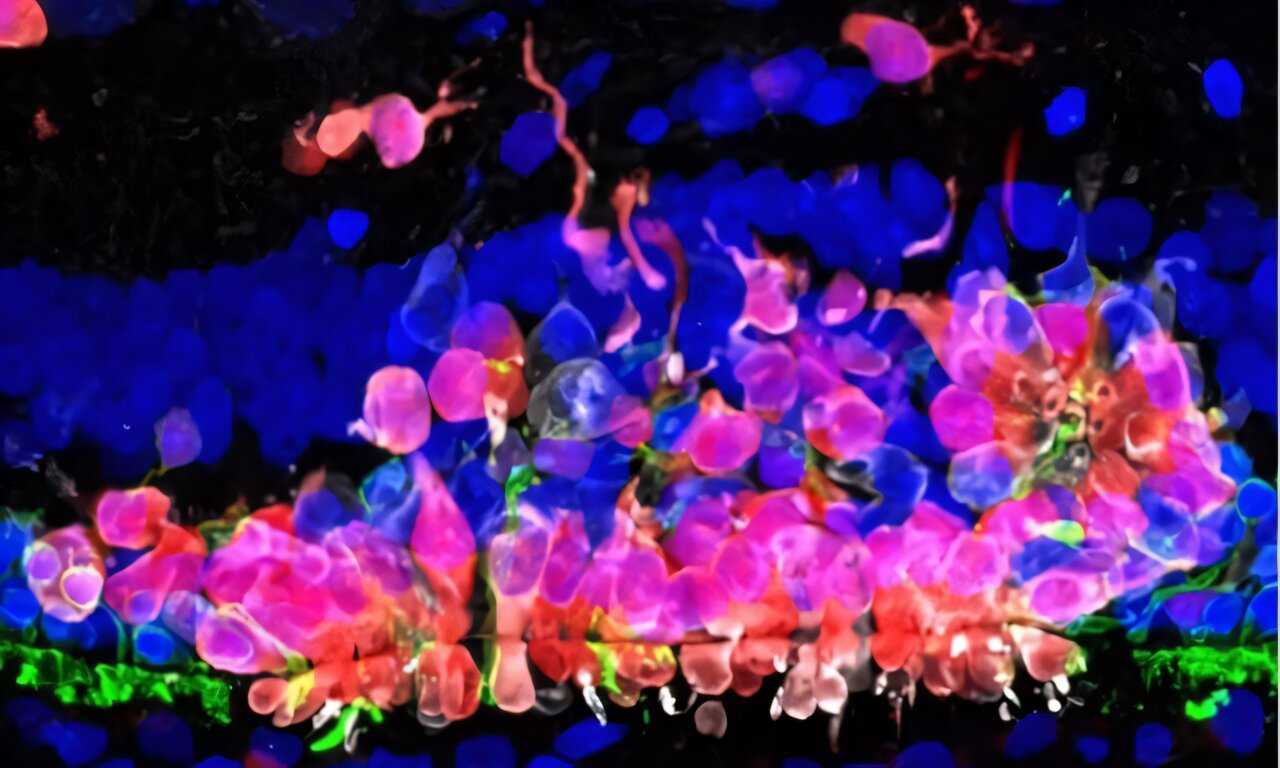
Using noninvasive imaging, the researchers found that early donor cell death was consistently observed, regardless of whether the host retina was healthy or already undergoing degeneration. To uncover the underlying cause, they performed single-cell RNA sequencing on transplanted cells in healthy retinas, which revealed signatures of acute metabolic stress. These findings were further validated by immunohistochemistry, confirming that the transplanted cells were undergoing oxidative damage and cell death shortly after transplantation.
Still, the study revealed a positive aspect: a subset of donor cells did survive and continued to mature after transplantation. In retinas that retained some of the native photoreceptors, these surviving cells were even able to begin forming structures that resembled synaptic connections.
The timing of transplantation proved to be crucial. In models where portions of the retina’s photoreceptor layer were still intact, donor cells could integrate into the host tissue. But in cases of end-stage degeneration, where the retinal architecture was too far gone, transplanted cells failed to survive.
“These findings suggest that some damage to the native photoreceptor layer is actually necessary to allow transplanted cells to integrate,” said Beltran, the Corinne R. and Henry Bower Professor of Ophthalmology and director of the Division of ExpeRTs. “But if degeneration progresses too far, the retinal environment becomes too hostile to support their survival.”
The study highlights a critical therapeutic window: a stage in disease progression where the retina is damaged enough to permit integration, but not so far gone that it can no longer support transplanted cells.
Supported by the National Eye Institute and several vision research foundations, the study defines a major challenge in retinal cell therapy and points to tangible strategies for overcoming it. Therapies that aim to replace lost photoreceptors must not only be timed appropriately but also include strategies to protect donor cells from early metabolic stress—such as preconditioning, scaffold-based delivery, or nutrient support.
“As the field moves closer to clinical translation,” said Sudharsan, “understanding how both the transplanted cells and the host retina respond will be essential to designing therapies that actually succeed in patients.”
More information:
Raghavi Sudharsan et al, Metabolic stress and early cell death in photoreceptor precursor cells following retinal transplantation, Stem Cell Research & Therapy (2025). DOI: 10.1186/s13287-025-04509-w
Citation:
Study finds key to improving survival of transplanted retinal cells (2025, August 5)
retrieved 5 August 2025
from https://medicalxpress.com/news/2025-08-key-survival-transplanted-retinal-cells.html
This document is subject to copyright. Apart from any fair dealing for the purpose of private study or research, no
part may be reproduced without the written permission. The content is provided for information purposes only.