by Pan Lei and Zhao Weiwei, Hefei Institutes of Physical Science, Chinese Academy of Sciences

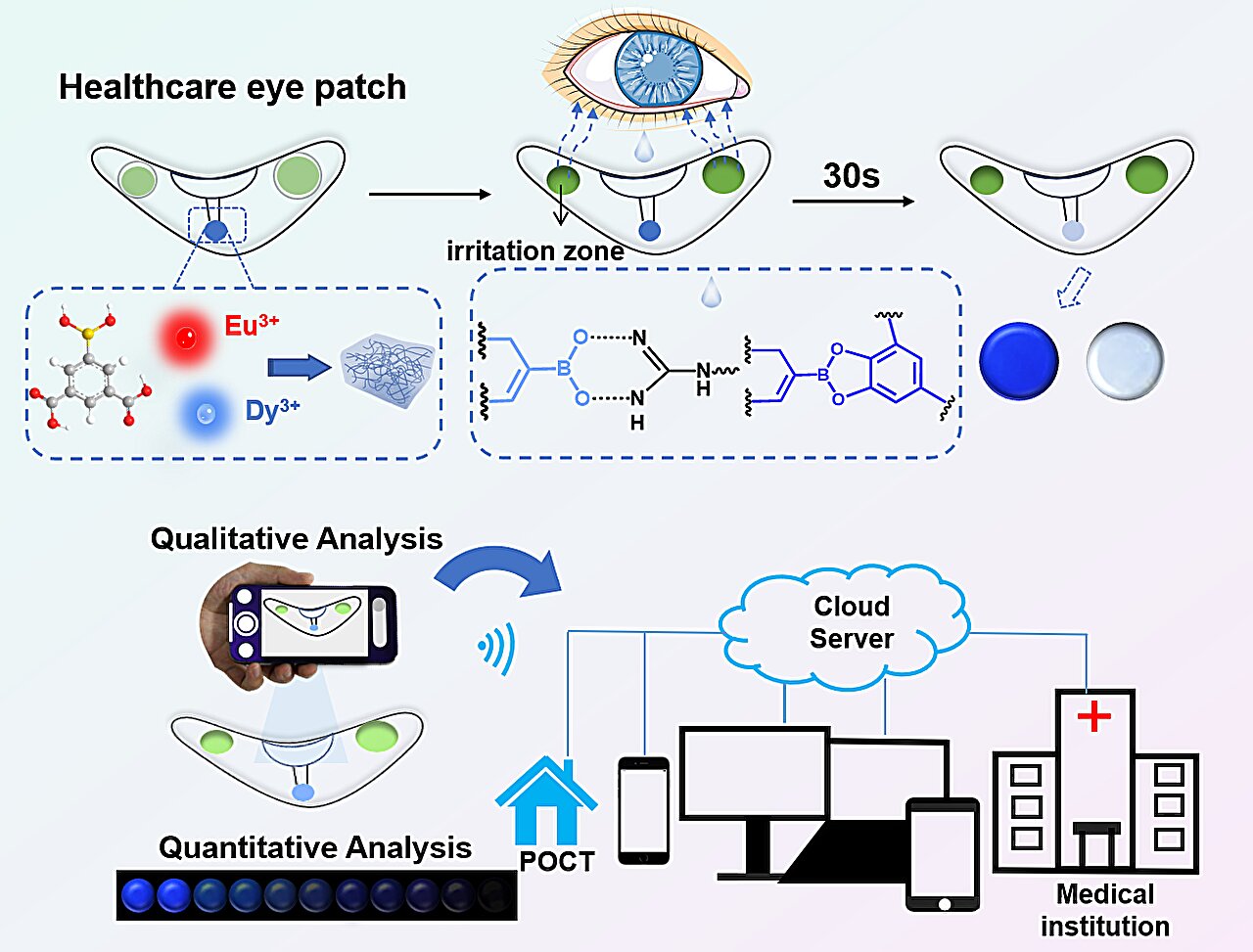
A research team has used multi-emission metal organic framework hydrogel (Eu-Dy MOF gel) to construct a noninvasive wearable eye patch fluorescence sensor, combined with the color recognition function of a smartphone to analyze and monitor lysozyme in tears.
The research results are published in Analytical Chemistry. The team was led by Prof. Jiang Changlong from the Institute of Solid State Physics, the Hefei Institutes of Physical Science of the Chinese Academy of Sciences.
Lysozyme, often called “the body’s own antibiotic,” plays a crucial role in protecting the eyes from infection. As an important biomarker for various eye diseases, monitoring its levels in tears can offer valuable insights into eye health. However, traditional methods for detecting lysozyme are often invasive or require complex equipment.
In this study, the research team proposed a noninvasive fluorescent visualization detection method, expanding the application range of eye patch fluorescent sensors. First, the functionalized Eu-Dy MOF gel probes integrated into the eye patch sensors are used as sensing units. Tear fluids secreted by the eyes are collected via the eye patches applied to the skin beneath the eyes.
The color signal generated by the sensing area on the eye patch under ultraviolet light are then captured using the camera function of a smartphone, and analyzed using color recognition software on the device.
The researchers point to the “antenna effect” as the reason for using MOF materials. In this mechanism, organic ligands in the MOF absorb light energy and transfer it to lanthanide ions like Eu³⁺ and Dy³⁺, which then emit visible fluorescence. This efficient energy transfer makes MOF gels ideal for sensitive optical sensing.

In the presence of lysozyme, the Eu-Dy MOF gel forms complexes with the protein, leading to a quenching of blue fluorescence through static quenching and local electron transfer. The system demonstrated a detection limit as low as 1.5 nanomolar, making it highly sensitive for real-time monitoring.
“Our finding holds great potential for noninvasive detection of lysozyme in tears, promoting the widespread application of functionalized MOF fluorescent sensors in personal health monitoring, disease early warning, diagnosis and treatment fields,” said Prof. Jiang.
More information:
Lei Pan et al, Rare Earth Ion-Induced Functionalized Fluorescent MOF Hydrogel Patches for Monitoring Lysozyme in Tears, Analytical Chemistry (2025). DOI: 10.1021/acs.analchem.5c00346
Provided by
Hefei Institutes of Physical Science, Chinese Academy of Sciences
Citation:
Smart eye patch uses fluorescence to monitor eye health (2025, August 29)
retrieved 31 August 2025
from https://medicalxpress.com/news/2025-08-smart-eye-patch-fluorescence-health.html
This document is subject to copyright. Apart from any fair dealing for the purpose of private study or research, no
part may be reproduced without the written permission. The content is provided for information purposes only.