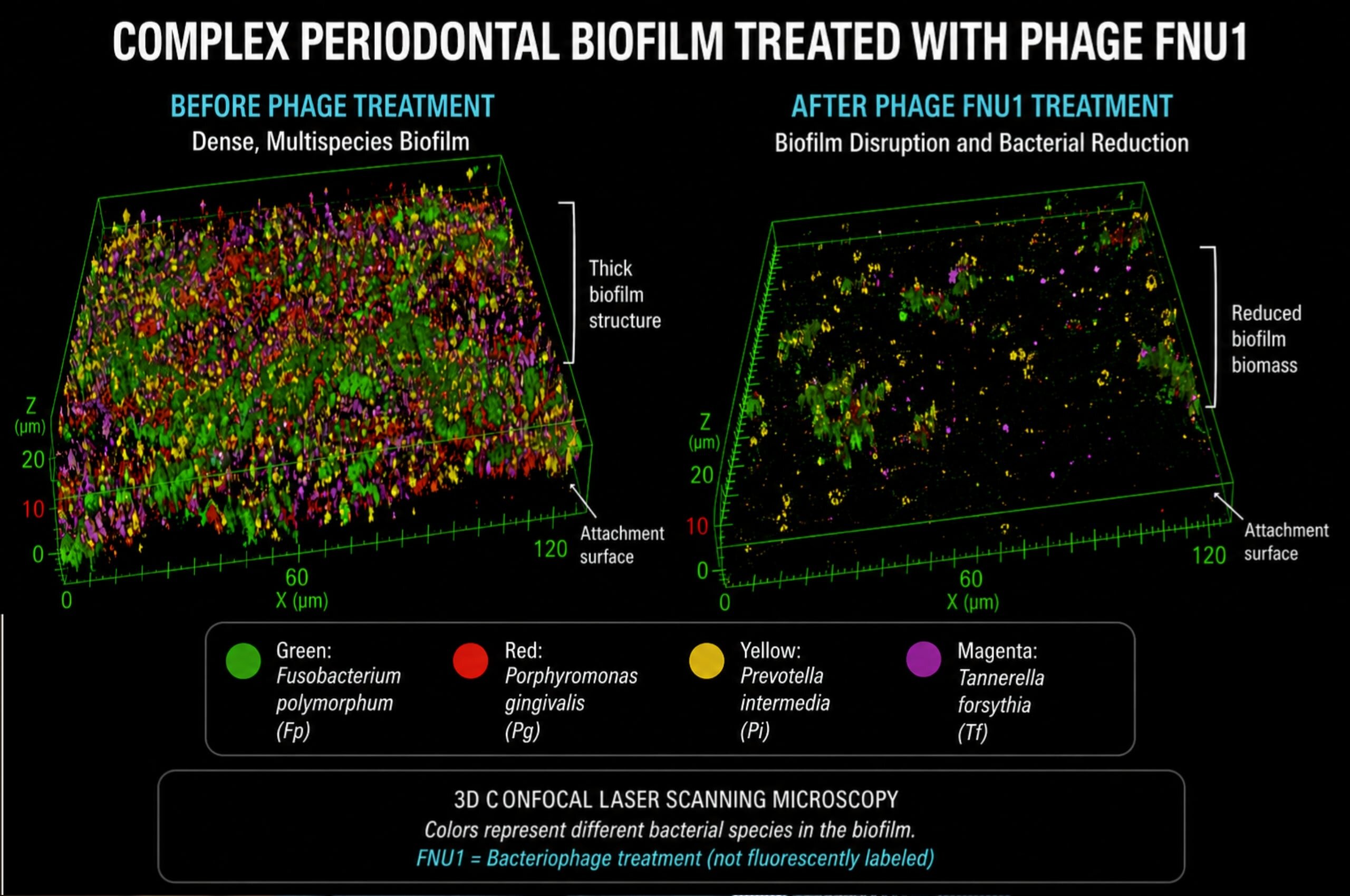

Scientists have shown that a naturally occurring virus can dismantle complex bacterial communities responsible for severe gum disease, offering a potential alternative to traditional antibiotics. In the first study to demonstrate this effect, La Trobe University researchers found that the FNU1 virus selectively attacked Fusobacterium polymorphum, a bacterial species that helps other disease-causing bacteria stick together and thrive.
The virus reduced total bacterial levels by 94%, leaving only about 6% of the original disease-causing plaque intact. Despite targeting just one bacterial species, the treatment dramatically reduced the size and density of the plaque, with levels of three other bacteria linked to gum disease falling by more than 85%.
Dr. Mwila Kabwe, lead author and postdoctoral research fellow at La Trobe’s Holsworth Biomedical Research Center, said the findings were important because gum disease affects more than half the world’s population and remains a leading cause of tooth loss.
The research, published in the Journal of Oral Microbiology, focused on bacteriophages, or phages, viruses that infect bacteria but are harmless to humans.
“Current treatments for gum disease don’t directly target the bacterial imbalance that drives the disease, and the dense layers of bacteria that form around teeth can be resistant to antibiotics,” Kabwe said. “By targeting one of the key bacteria that holds these disease-causing communities together, we were able to destabilize the entire plaque community.
“The findings suggest phages could offer a more precise way to treat gum disease while preserving healthy bacteria.”
While the laboratory findings are promising, further research is needed before phage-based treatments could be used in dental practice.
The study forms part of Kabwe’s early-career research investigating how phages could be used to target harmful bacteria linked to oral disease and other chronic health conditions.
More information
Siti Saleha Binte Mohamed Yakob Adil et al, Fusobacterium bacteriophage FNU1 disrupts complex periodontal pathogenic biofilms comprising Fusobacterium polymorphum , Porphyromonas gingivalis , Tannerella forsythia and Prevotella intermedia, Journal of Oral Microbiology (2026). DOI: 10.1080/20002297.2026.2726627
Key medical concepts
Clinical categories


Citation:
Scientists target gum disease with bacteriophage virus (2026, September 14)
retrieved 16 October 2026
from https://medicalxpress.com/news/2026-09-scientists-gum-disease-bacteriophage-virus.html
This document is subject to copyright. Apart from any fair dealing for the purpose of private study or research, no
part may be reproduced without the written permission. The content is provided for information purposes only.