
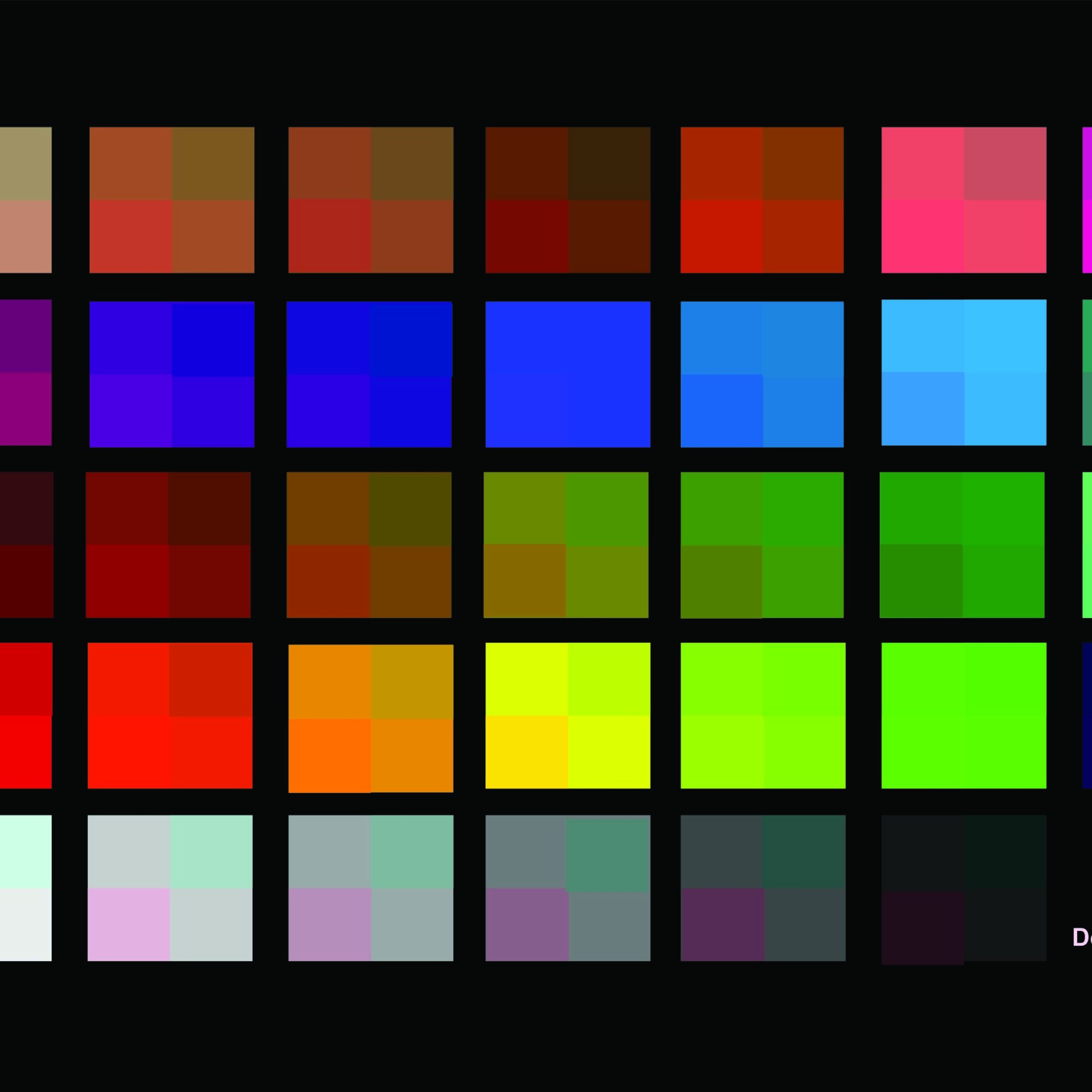

A new computational model that accounts for individual differences in human color vision is helping reveal why the colors of today’s displays sometimes appear different to different people. The new information could help guide the development of displays that deliver a more consistent viewing experience across a wider range of color vision.
Displays—whether a television or the screen of a smartphone—use a combination of red, green and blue primary emissions to create a wide range of colors. Although the colors on most older displays tended to look similar to most viewers, some modern displays use narrowband sources for primary colors, yielding a larger color gamut and a wider range of colors but also introducing greater variability among viewers.
“The people who produce films and TV shows want their work to look the same whatever device it is being viewed on, which is complicated by differences in people’s color vision and outdated calibration methods,” said Andy Rider from the Institute of Ophthalmology at University College London. “Our model takes into account individual variability in color vision and can be used to determine how best to adjust the three primary colors of a specific display to provide the best viewing experience for as many people as possible.”
In a new report in the journal Optics Express, the researchers used their model to analyze 16 displays, including televisions, professional monitors used in film production and cinema projectors, finding that some displays exhibit much larger color discrepancies than others.
“Although this research focused on displays, the modeling approach can also be used to examine similar color discrepancies such as those from energy-efficient LED lighting compared to traditional incandescent lightbulbs or in other color applications where dyes and pigments change how objects reflect or absorb light,” said Rider.

Capturing individual differences in color vision
Recent years have seen a push to produce TVs and cinema projectors with a greater color range and more vivid colors. However, because of individual differences in human color vision, these wide-gamut displays produce frequent color mismatches between different types of displays even when calibrated to appear identical.
“Producing consistent images also requires good display calibration, but most calibration devices use color standards developed about 100 years ago that don’t align with normal color vision,” said Rider. “This can make modern displays look wrong even when they have been calibrated to look the same. We wanted to better understand how and when color reproduction might go wrong, and how to fix it.”
To help solve this problem, the researchers developed a model of human color vision that captures differences in color perception. For example, they modeled deuteranomaly, a common form of red-green color vision deficiency that affects about 1 in 20 men, by shifting the wavelengths detected by the eye’s cone cells, which are responsible for color vision. They also modeled age-related and person-to-person differences in the eye’s lens by varying the amount of short-wavelength light the lens filters before it reaches the retina.
A realistic view of modern displays
“We combined our realistic model of human color vision with displays that are usually calibrated and analyzed in a more engineering-based framework,” said Rider. “These calibrations are usually done using devices like photometers and colorimeters that measure light output and poorly simulate its effect on human vision. Our model helps improve these simulations.”
It also showed that the spectrum of the blue primary light strongly influences how displays are seen by people of different ages, while the spectra of the red and green primaries affect people with different kinds of red-green color vision deficiency. Thus, changing the spectrum of the primary lights could help reduce the mismatches seen by different observers.
The researchers note that their work is based on a physiological model of color vision that draws on their own research, but the model’s predictions haven’t been verified with real human observers. In the future, they plan to validate the predictions and use what they’ve learned to guide the development of displays that produce a wide gamut of vivid colors with better color consistency. It might be possible, for example, to use more than three primary light sources in a display, which would allow finer adjustments to produce accurate colors for a wider range of people.
Publication details
Andrew Rider et al, Why the colours of modern displays can look so different to different observers, Optics Express (2026). DOI: 10.1364/oe.613255
Journal information:
Optics Express
Clinical categories


Citation:
New research reveals why modern display colors can look different to different people (2026, October 1)
retrieved 16 October 2026
from https://medicalxpress.com/news/2026-10-reveals-modern-display-people.html
This document is subject to copyright. Apart from any fair dealing for the purpose of private study or research, no
part may be reproduced without the written permission. The content is provided for information purposes only.
