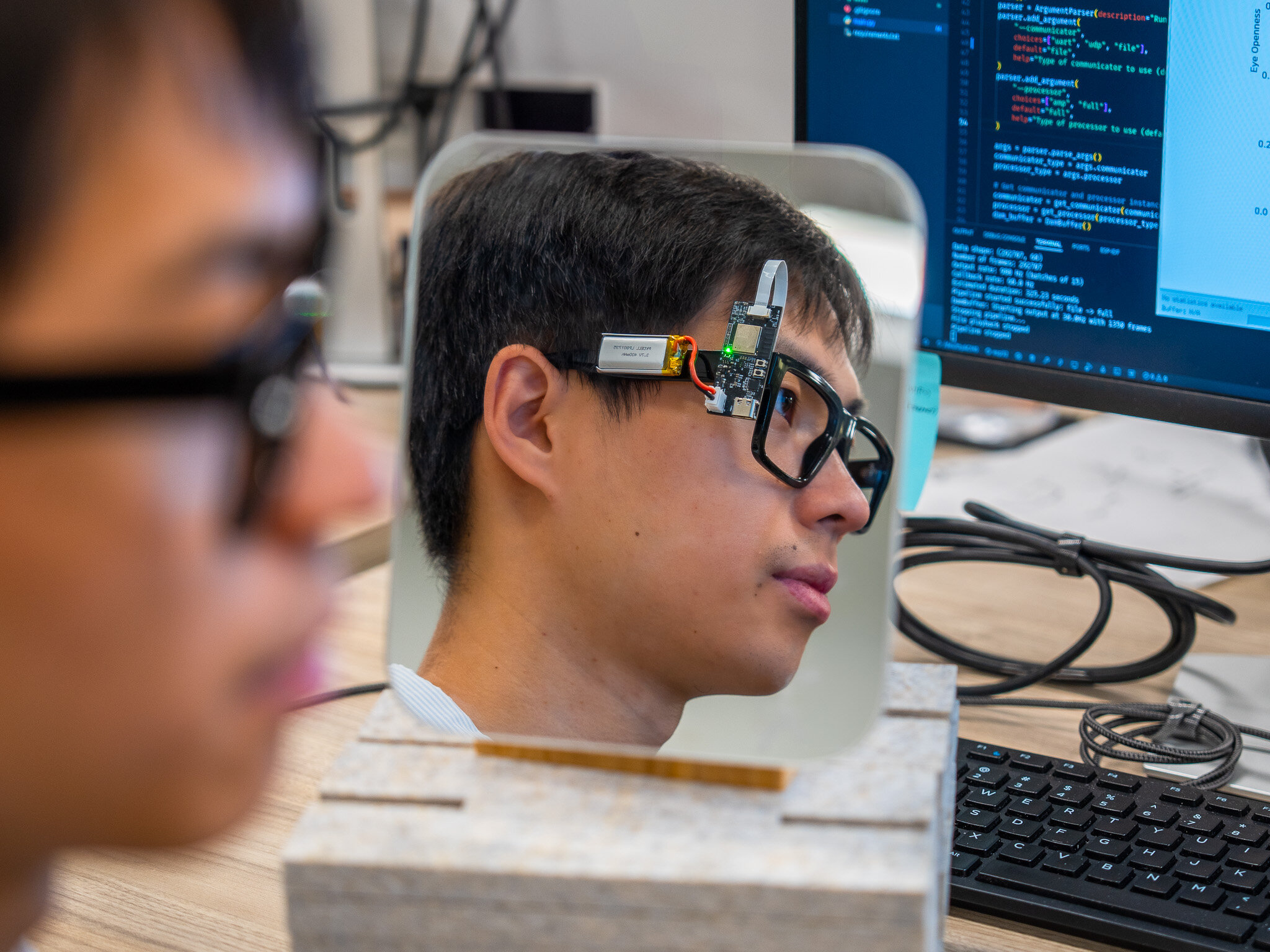

Penn researchers have developed an AI-powered device that turns ordinary glasses into a smart, energy-efficient health monitor by watching you blink.
The device, called BlinkWise, uses radio signals to track eyelid movements with unprecedented detail, all while preserving privacy and using minimal power. The technology opens doors for assessing fatigue, mental workload and eye-related health issues in real-world settings, from long-haul trucking to everyday office work.
“Because BlinkWise brings together low-power radio-wave sensing and edge AI,” says Mingmin Zhao, assistant professor in computer and information science (CIS) and one of the lead researchers on the project, “it can sense more efficiently and run advanced health monitoring directly on the glasses with less energy, less space and less data than existing ‘smart’ eyewear.”
While initial applications focus on health and safety, BlinkWise could also serve as the foundation for a new generation of smart eyewear. “For glasses to be truly ‘smart,'” says Zhao, “they need to do more than respond to voice commands and take pictures. They need to actually understand the wearer. Blinkwise is the first step in that direction.”
Eyes: A window into health
The average person blinks over 10,000 times per day. Each blink offers a fingerprint of one’s physiological and mental state, capturing information about fatigue, focus, eye dryness and more.
But it’s not just whether a person blinks. How they blink matters, too. Researchers refer to this pattern as blink dynamics: characteristics such as blink duration, the completeness of each blink (full vs. partial), and the timing of eyelid closure and reopening. These details provide significantly more information than simply recording whether the eyelid is open or closed.
“The saying goes that the eyes are the window to the soul,” says Lama Al-Aswad, Irene Heinz Given and John La Porte Given Research Professor of Ophthalmology II and a collaborator on the project. “But blinking—how often, how fully, how long—also gives us a window into the body and brain.”
For example, longer eyelid closures can signal drowsiness, a leading cause of car accidents that cost the U.S. economy more than $100 billion annually. An increase in partial blinks can point to dry-eye disease, which affects more than 16 million Americans.
“Blinking is something we do thousands of times per day without thinking, and yet it reflects so much about our health,” says Al-Aswad, who previously collaborated with Zhao to assess cardiovascular risk via the eyes. “Because it’s noninvasive and easy to monitor, blink analysis could become a powerful tool for managing chronic conditions and identifying cognitive changes early.”

More precise and portable blink analysis
These blink dynamics unfold in milliseconds. Until now, tracking blink dynamics at this resolution demanded stationary, high-speed cameras and specialized equipment.
“Previous systems required a lab setup,” says Dongyin Hu, the lead author of a paper the team presented at MobiSys 2025 and a doctoral student in CIS. “BlinkWise just clips onto your glasses, so you can monitor blinks anywhere.”
Instead of capturing images, BlinkWise bounces radio waves off the eye to detect minute movements of the eyelid. The system translates the signal into an “eye openness score,” a curve that models blinking in real time, rather than simply classifying the eye as open or closed.
This millisecond-level precision offers a major advantage over conventional systems. “Cameras typically record at 30 or 60 frames per second, which isn’t fast enough to fully capture a blink,” Hu explains. “With radio frequency sensors, we can sample thousands of times per second, enabling much more detailed analysis.”
AI that fits on your face
To make BlinkWise wearable, the team had to overcome a key challenge: how to run advanced AI on a tiny device using minimal power. Rather than send data to a smartphone or cloud server, BlinkWise processes everything locally on a chip smaller than a postage stamp.
The researchers adapted techniques from image processing and machine learning to create a compact model that can interpret radio signals in real time. In the process, they also reimagined the entire AI pipeline to suit the tight constraints of wearable hardware and the fact that the signal streams continuously. These new approaches make BlinkWise exceptionally efficient.
“Smart glasses have to do a lot, so we didn’t want blink tracking to drain the battery or take up too much computing power,” says Insup Lee, Cecilia Fitler Moore Professor in CIS and director of the Penn Research in Embedded Computing and Integrated Systems (PRECISE) Center.
BlinkWise, by contrast, generates only a small, targeted radio wave signal, which means less data to handle and less energy required to analyze it. “In fact,” Lee adds, “our system uses less power to process the radar signal than it would take just to transmit camera footage over Wi-Fi.”

Toward truly smart glasses
While BlinkWise is already useful for assessing fatigue, eye dryness and mental workload, the team sees it as just the beginning.
“Today’s smart glasses can take photos or play audio, but they don’t really understand the wearer,” says Zhao. “We believe devices like BlinkWise are the first step toward eyewear that responds to your cognitive state, not just your voice commands.”
Glasses also offer a unique advantage over watches or phones: they sit directly in front of the eyes, providing a front-row view into mental and physical states. “We see BlinkWise not just as a health monitor,” Hu says, “but as a building block for glasses that are truly intelligent.”
More information:
Tracking Blink Dynamics and Mental States on Glasses, Proceedings of the 23rd Annual International Conference on Mobile Systems, Applications and Services (2025). DOI: 10.1145/3711875
Citation:
AI at the eyelid: Glasses that track health through your blinks (2025, September 30)
retrieved 30 September 2025
from https://medicalxpress.com/news/2025-09-ai-eyelid-glasses-track-health.html
This document is subject to copyright. Apart from any fair dealing for the purpose of private study or research, no
part may be reproduced without the written permission. The content is provided for information purposes only.