

BBC Newsnight

 BBC Newsnight
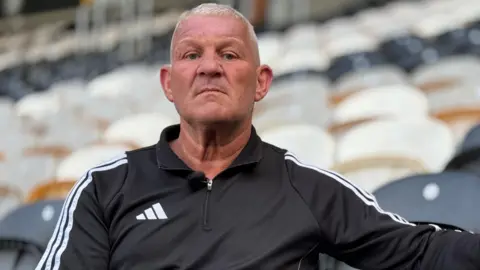
Former footballer Dean Windass says he is scared for the future following his stage two dementia diagnosis and wants more support for other players and their families in the same position.
The 55-year-old, who played for 12 clubs during a professional career spanning 19 years, was diagnosed last year and the news was announced in January.
Windass told BBC Newsnight he was trying not to let the illness affect him, but “has a cry every now and then”.
“It scares me,” he admitted. “I don’t know what the outcome’s going to be. Interview me in 10 years’ time and I might tell you a different story.”
Stage two dementia is an early phase of the syndrome in which people exhibit very mild cognitive decline, possibly including some memory lapses.
Windass said it was “emotional” for him when he underwent tests and although he doesn’t know what the future holds, said he was trying to live as normal a life as possible.
He added: “There’s nothing I can do. You can’t roll back the years, so you’ve just got to deal with it as much as you can.
“Hopefully, in the next five or 10 years it doesn’t develop. It might do, but it might not. So, you get up in the morning and you live. You try to live your life as normal.”
Windass was part of the Bradford City side promoted to the Premier League in 1999 and wrote his name into Hull City folklore with the only goal in the Championship play-off final at Wembley in 2008.
He also had stints at Aberdeen, Oxford, Middlesbrough and Sheffield United during a career that saw him amass more than 700 appearances and score more than 230 goals.
“If they’d said [when playing] that in 10 years’ time you might have a shade of dementia. I’d go ‘well I’m not heading that ball then’,” Windass added.
“I wouldn’t have done that as much in training… [I’d] probably think twice.”
In his first broadcast interview since the diagnosis, Windass spoke candidly about the impact the news was having on his mental health and his family.
He said he believed his diagnosis was a direct result of repeatedly heading the ball, and had concerns for his two sons, Josh and Jordan, both of whom are footballers.
“I don’t want them to worry because at the minute I’m alright,” he explained.
A study by Glasgow University in 2019 found former professional footballers were almost three-and-a-half times more likely to be diagnosed with dementia than the general population.
Windass said he wanted to raise awareness of dementia and get players’ union the Professional Footballers’ Association (PFA) to increase its support to affected players and their families.
“The one thing I love about myself is trying to help as many people as I can in any way, shape or form,” he said.
“The reason why we’ve done this [interview] is to help the families, because my family might need help in 10 or 15 years’ time. So I don’t want them to suffer as well.
“At this present time, if I can help or we can help people and push the PFA to help these people … that’s what we’re trying to do and trying to achieve.”
The PFA said it invested more than £1m in a brain health fund after a group of 30 former footballers and their families launched legal action in 2022 against football’s governing bodies, claiming they failed to protect them from brain injuries.
The Premier League has also contributed to the fund, which according to the PFA, aims to provide industry-wide support to players living with dementia and other neurodegenerative conditions.
Reassurances over future
Windass is part of the Football Families for Justice (FFJ) group, which is a voluntary organisation dedicated to championing the rights and well-being of former players with neuro-degenerative diseases.
Also part of the group is former Manchester United and Blackburn defender David May, who announced the news of Windass’s diagnosis.
He has said he is hoping that by speaking about it, Windass can help others in the future.
May said: “When I asked Deano if I could mention it, I didn’t think it’d go as viral as what it has done.
“And in a way, it’s an absolute blessing because other people can benefit from Deano coming out and speaking about it.
“He’s talking about 10 or 15 years from now, he wants some reassurances that in 10 or 15 years’ time those plans are being put in place, so he doesn’t have to rely on his family and that there will be carers to help him.”


