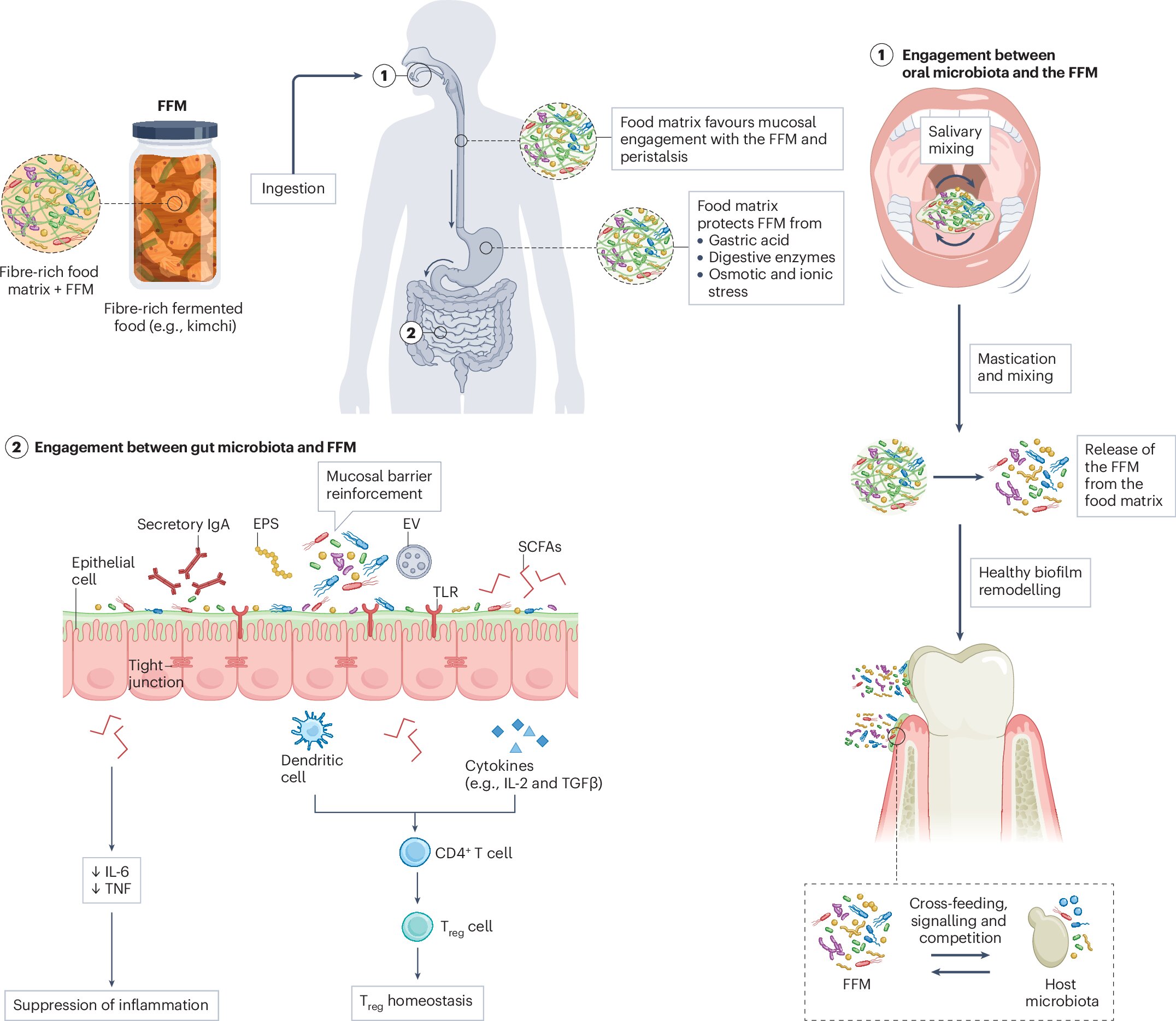

Fermented plant-based foods such as kimchi and sauerkraut could help inspire a new generation of microbiome-informed dietary strategies for supporting oral and gut health, according to a review paper published in Nature Reviews Microbiology. The study, led by investigators at Penn’s School of Dental Medicine with collaborators at Penn Medicine, Penn Nursing and Jeonbuk National University in South Korea, examines how fermented foods interact with the microbes that live in the mouth and gut.
The authors focus on plant-based fermented foods, which can carry diverse communities of live microorganisms, microbial metabolites, fiber-rich food structures and plant-derived bioactive compounds. Recognizing these distinctive features, the authors set out a roadmap for developing fermented foods into microbiome-based precision nutrition strategies to support health.
“Fermented plant-based foods carry diverse microbial populations along with their metabolites and, in principle, could be tailored to support oral and gastrointestinal health,” says study co-corresponding author Hyun Koo, professor in the departments of endodontics and bioengineering and co-founding director of the Center for Innovation & Precision Dentistry at Penn Dental Medicine.
Yogurt and other liquid probiotics are already widely used to modify the gut microbiome to promote better digestion. But the researchers note that the potential health benefits of fermented foods could extend beyond dairy products and that solid, plant-based fermented foods have distinct features compared with liquid ones.
“Plant-based fermented foods may have an advantage not only in their efficiency in delivering microbes to the host but also by providing unique benefits via bioactive phytochemicals that have been shown to promote human health,” says Gary Wu, the Ferdinand G. Weisbrod Professor in Gastroenterology at the Perelman School of Medicine. Charlene Compher, professor of nutrition science at Penn Nursing, also participated in this project.
The authors propose a roadmap for moving the field forward. Key steps include building better databases of food microbiomes, using advanced tools to profile microbial strains and metabolites, and developing plant-based fermented food products with defined microbial and chemical features.
Publication details
Dongyeop Kim et al, Fermented food microbiome: influence on oral and gut microbiota, and human health, Nature Reviews Microbiology (2026). DOI: 10.1038/s41579-026-01333-8
Journal information:
Nature Reviews Microbiology


Citation:
Turning fermented food into precision-nutrition for oral and gut health (2026, August 3)
retrieved 17 October 2026
from https://medicalxpress.com/news/2026-08-fermented-food-precision-nutrition-oral.html
This document is subject to copyright. Apart from any fair dealing for the purpose of private study or research, no
part may be reproduced without the written permission. The content is provided for information purposes only.