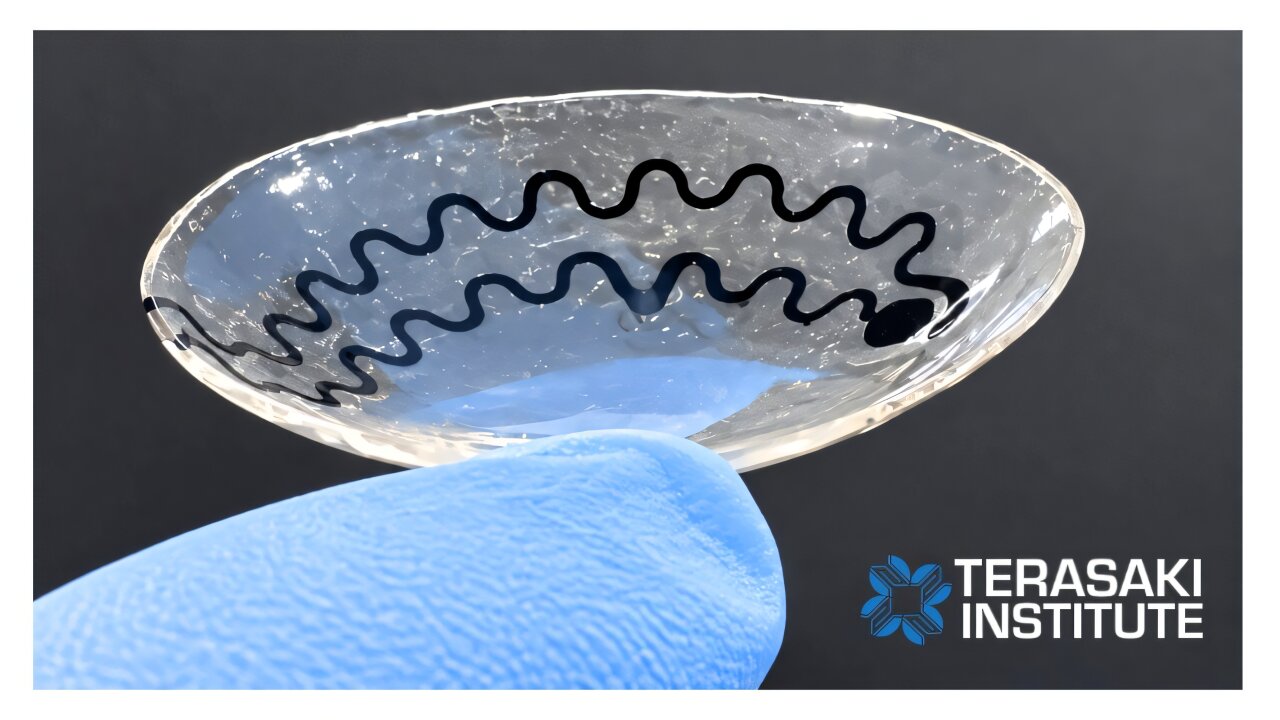

A research team led by Dr. Yangzhi Zhu, principal investigator and assistant professor at the Terasaki Institute for Biomedical Innovation, has developed a soft, reusable smart contact lens as part of its broader Ocular Library for the Analysis of Tear Biomarkers (OCULAB), a tear bioelectronics platform for noninvasive, longitudinal biochemical monitoring through the ocular surface and tear film. In this study, the platform was used to measure serotonin directly from tears as a proof-of-concept target for monitoring stress-related physiological changes.
Stress affects many aspects of physical and mental health, yet physiological changes associated with stress can be difficult to monitor objectively over time. Serotonin is an important signaling molecule involved in mood regulation and stress-related physiology. It is also present in tears, making tear fluid an attractive, minimally invasive source of biochemical information. The study was designed to explore whether a soft ocular bioelectronic platform could sensitively detect serotonin in this small and dynamic biofluid.
A reusable lens detects tear serotonin
The team developed the device, termed a lab-on-a-contact-lens, by integrating a thin, flexible sensor into a standard soft contact lens. The sensor uses a compound called ferrocene, which reacts with serotonin to generate a small electrical signal that can be measured and converted into a concentration reading. The work, published in Science Translational Medicine, showed that the sensor could detect serotonin at concentrations as low as 72 picomolar, roughly 200 times more sensitive than needed to measure typical human tear serotonin levels. That sensitivity allows it to reliably detect small changes.
In a mouse model of chronic stress, tear serotonin concentrations dropped while cortisol, a well-known stress hormone, rose in both blood and tears, echoing patterns seen in prior human stress research. In a small pilot study, tear samples collected from 10 volunteers during a standardized stress test showed a similar pattern, with serotonin levels falling during the stressful task and returning toward baseline afterward. The lens also maintained accurate readings across up to 400 uses over several days, suggesting it could be reused rather than replaced after each measurement.
“Tears carry more information about our bodies than most people realize,” said Dr. Minwoo Kim, first author and postdoctoral researcher at the Terasaki Institute for Biomedical Innovation. “This lens lets us read some of that information without needles or lab visits, right from something people already wear.”
“The eye provides a unique window into both ocular and systemic physiology,” said Zhu, principal investigator and assistant professor at the Terasaki Institute. “Through our ocular bioelectronics program, we are developing soft ocular devices that can turn the tear film into a source of longitudinal biochemical information. Serotonin is an important proof-of-concept target, but the broader goal is to build wearable ocular systems capable of monitoring multiple biomarkers and physiological signals over time.”
Wireless monitoring still faces hurdles
The team’s next step is to move from the current laboratory-connected platform toward a fully integrated wearable system. The team plans to integrate wireless components so a future version of the lens can acquire and transmit readings in real time while being worn, rather than requiring tear samples to be collected and analyzed afterward.
Larger and more diverse human studies will be needed to determine how tear serotonin relates to stress and mental health across different populations. Long-term sensor stability, calibration in the dynamic tear environment, comfort, manufacturing reproducibility and extended on-eye safety will also need to be established before the technology can move toward clinical use.
The eye as a health interface
More broadly, the work establishes a framework for ocular bioelectronics, the integration of soft electronics, biochemical sensing and wearable technologies with the ocular surface and tear film. Rather than viewing the contact lens solely as an optical device, the researchers envision it as a potential interface for continuously accessing physiological information in a minimally invasive manner.
“Our long-term vision is not simply to build a smart contact lens that measures one molecule,” Zhu said. “We want to establish tear bioelectronics as a broader platform for understanding dynamic physiology through the eye and, ultimately, for enabling more personalized and longitudinal approaches to health monitoring.”
By integrating soft contact lens materials, electrochemical biosensing, flexible electronics and future wireless capabilities, OCULAB represents a broader effort to transform the ocular surface into a noninvasive interface between the human body and digital health technologies.
Publication details
Minwoo Kim et al, Serotonin measurement by lab-on-a–contact lens in porcine and human tears, Science Translational Medicine (2026). DOI: 10.1126/scitranslmed.adv9538
Journal information:
Science Translational Medicine
Clinical categories


Citation:
Smart contact lens detects serotonin changes in tear samples collected during stress test (2026, September 24)
retrieved 16 October 2026
from https://medicalxpress.com/news/2026-09-smart-contact-lens-serotonin-samples.html
This document is subject to copyright. Apart from any fair dealing for the purpose of private study or research, no
part may be reproduced without the written permission. The content is provided for information purposes only.