
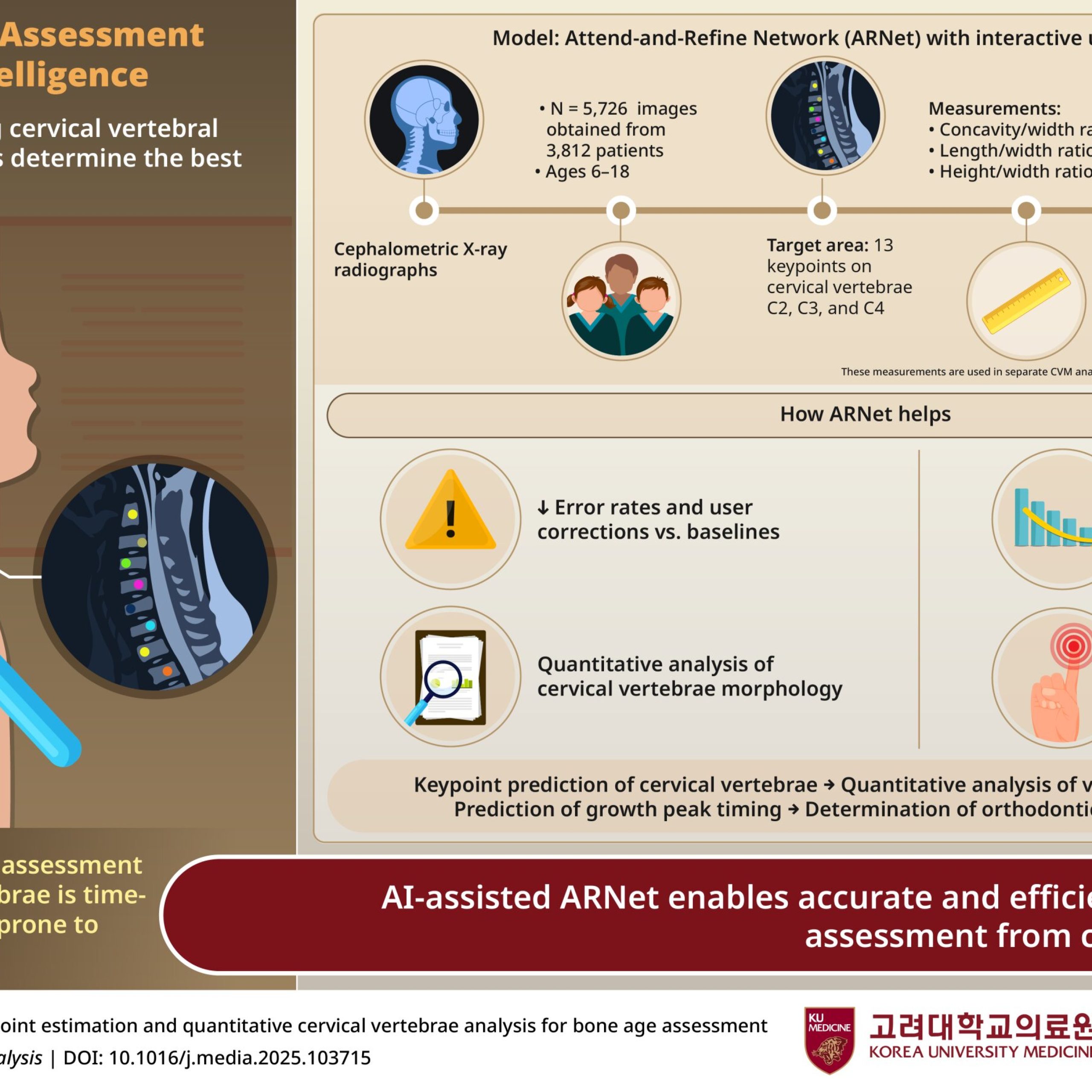

Orthodontic treatment is most effective when timed to coincide with a child’s growth peak. Traditionally, clinicians estimate growth by examining X-ray images of the cervical vertebrae—the neck bones visible in routine dental radiographs. However, this process requires careful manual annotation of specific points on the bones, a task that is both time-consuming and prone to variation between observers.
In Medical Image Analysis, researchers from Korea University Anam Hospital, KAIST, and the University of Ulsan introduce an artificial intelligence (AI) system designed to overcome these challenges.
The work, led by Dr. Jinhee Kim and Professor In-Seok Song, presents the Attend-and-Refine Network (ARNet-v2), an interactive deep learning model that streamlines growth assessment from a single lateral cephalometric radiograph.
ARNet-v2 automatically identifies skeletal landmarks on cervical vertebrae, allowing clinicians to predict a child’s pubertal growth peak. Unlike conventional techniques, the model requires minimal input: a single manual correction can be propagated across related anatomical points in the image, significantly improving both efficiency and accuracy.
Dr. Kim explained, “Importantly, the model allows a single correction by a clinician to automatically propagate to related keypoints across the image, enabling state-of-the-art accuracy with far fewer user interactions.”
The model was trained and tested on more than 5,700 radiographs and validated across four public medical imaging datasets. In direct comparison, ARNet-v2 outperformed existing systems, reducing prediction failures by up to 67% and halving the number of manual adjustments needed. This interactive approach not only enhances precision but also lowers the overall cost of medical image annotation.
Clinically, the system offers immediate benefits. By extracting detailed cervical vertebra features from one radiograph, ARNet-v2 can replace additional hand–wrist X-rays, reducing radiation exposure for children while ensuring timely orthodontic decision-making.
“Clinically, the model’s ability to extract precise cervical-vertebra keypoints from a single X-ray enables accurate estimation of a child’s pubertal growth peak, a key factor in determining the timing of orthodontic treatment. By replacing traditional hand-wrist radiographs, it can lower radiation exposure and costs for young patients,” noted Prof. Song.
Beyond orthodontics, the Attend-and-Refine framework shows promise for broader medical imaging challenges, such as brain MRI, retinal scans, and cardiac ultrasound. It may even extend to non-medical domains like robotics and autonomous driving, where rapid, high-quality annotation is crucial.
For clinical workflows, ARNet-v2 provides a notable boost in efficiency, easing workloads in busy hospitals and supporting resource-limited clinics or remote consultations.
Looking ahead, AI-assisted bone-age and growth assessment could become a routine component of pediatric care, combining automated analysis with personalized treatment planning. Dr. Kim emphasized, “Together, these aspects position our work as a significant step forward in AI-assisted bone-age assessment and pediatric orthodontics.”
By reducing unnecessary imaging, lowering costs, and improving diagnostic accuracy, this system offers clear advantages for both clinicians and young patients.
More information:
Jinhee Kim et al, Attend-and-Refine: Interactive keypoint estimation and quantitative cervical vertebrae analysis for bone age assessment, Medical Image Analysis (2025). DOI: 10.1016/j.media.2025.103715
Citation:
AI-assisted growth prediction advances orthodontics (2025, October 16)
retrieved 16 October 2025
from https://medicalxpress.com/news/2025-10-ai-growth-advances-orthodontics.html
This document is subject to copyright. Apart from any fair dealing for the purpose of private study or research, no
part may be reproduced without the written permission. The content is provided for information purposes only.

