
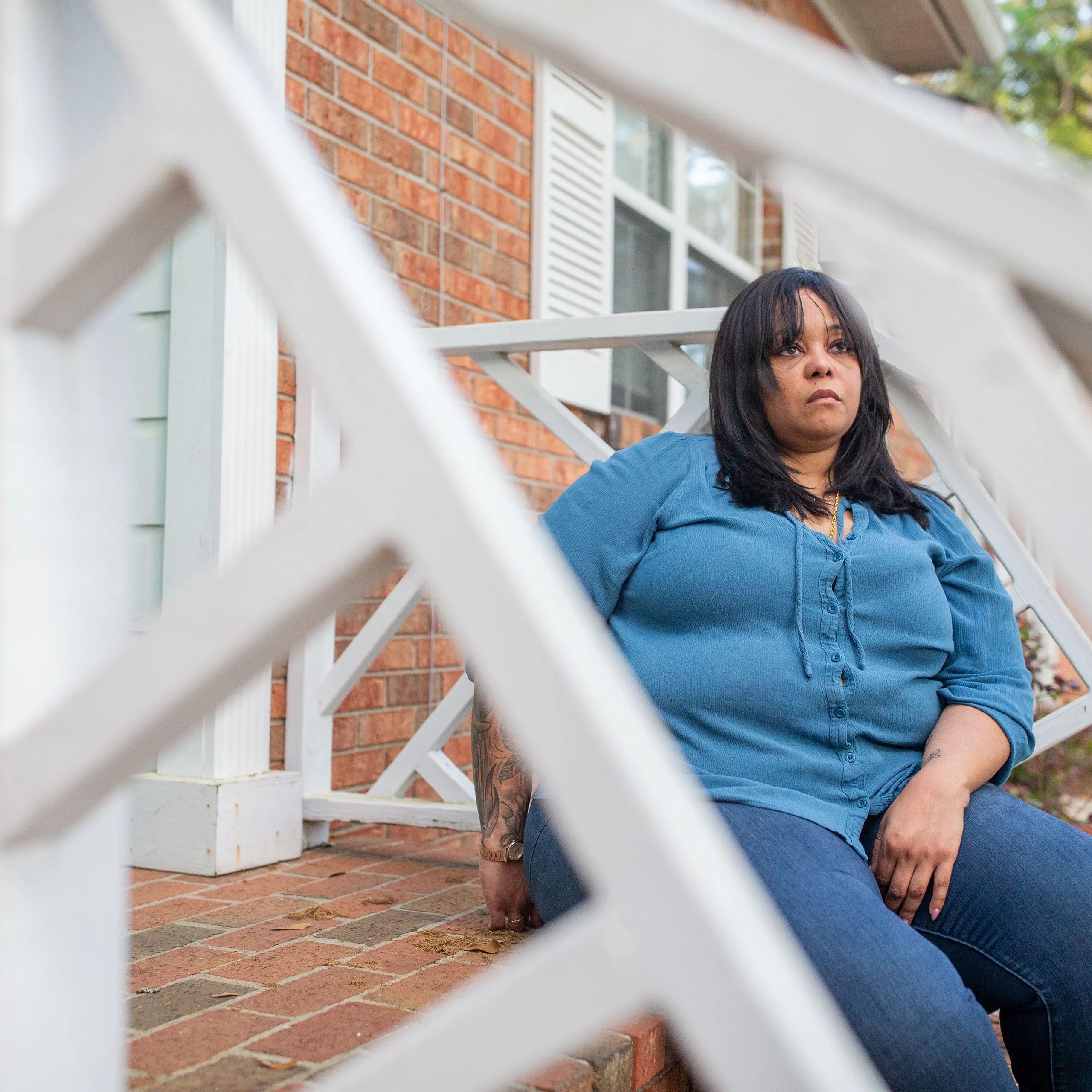
Alea Bates wasn’t ready to leave Tallahassee Memorial HealthCare’s main hospital four days after a stranger shot her seven times at close range. Miraculously, hospital records show, none of the bullets damaged her internal organs.
But after surgery, Bates said, she couldn’t get out of bed or walk to the bathroom without help. She complained of intense pain radiating down her left leg, weakness in her knee, and a numbing sensation below it, according to hospital records. Bates, who worked as an Uber Eats driver, didn’t have the strength to drive a car.
Still, Bates said, the hospital told her it was time to go.
“They didn’t do any further X-rays or CTs or MRIs to figure out why my knee was numb,” she said. “And they were just like, you know, ‘It’ll go away.’”
Doctors said she was medically stable, Bates said, and because she had no health insurance, they could not send her to a rehabilitation hospital or a skilled nursing facility, which can charge thousands of dollars a day for such care.
“They were just like, We need the bed for somebody who has insurance,” she said. “That’s of course, you know, what they say without saying it.”
At least one firearm injury is treated in an American emergency room every 30 minutes. Tens of thousands die from their injuries every year. Many more, like Bates, are left to face long recoveries, steep medical debt, and enduring trauma.
How insurance affects the care of gunshot wound victims has remained shrouded in mystery — until now, due to a new analysis by The Trace and KFF Health News of data that Florida hospitals compile to collect payments from insurance companies and file with the state.
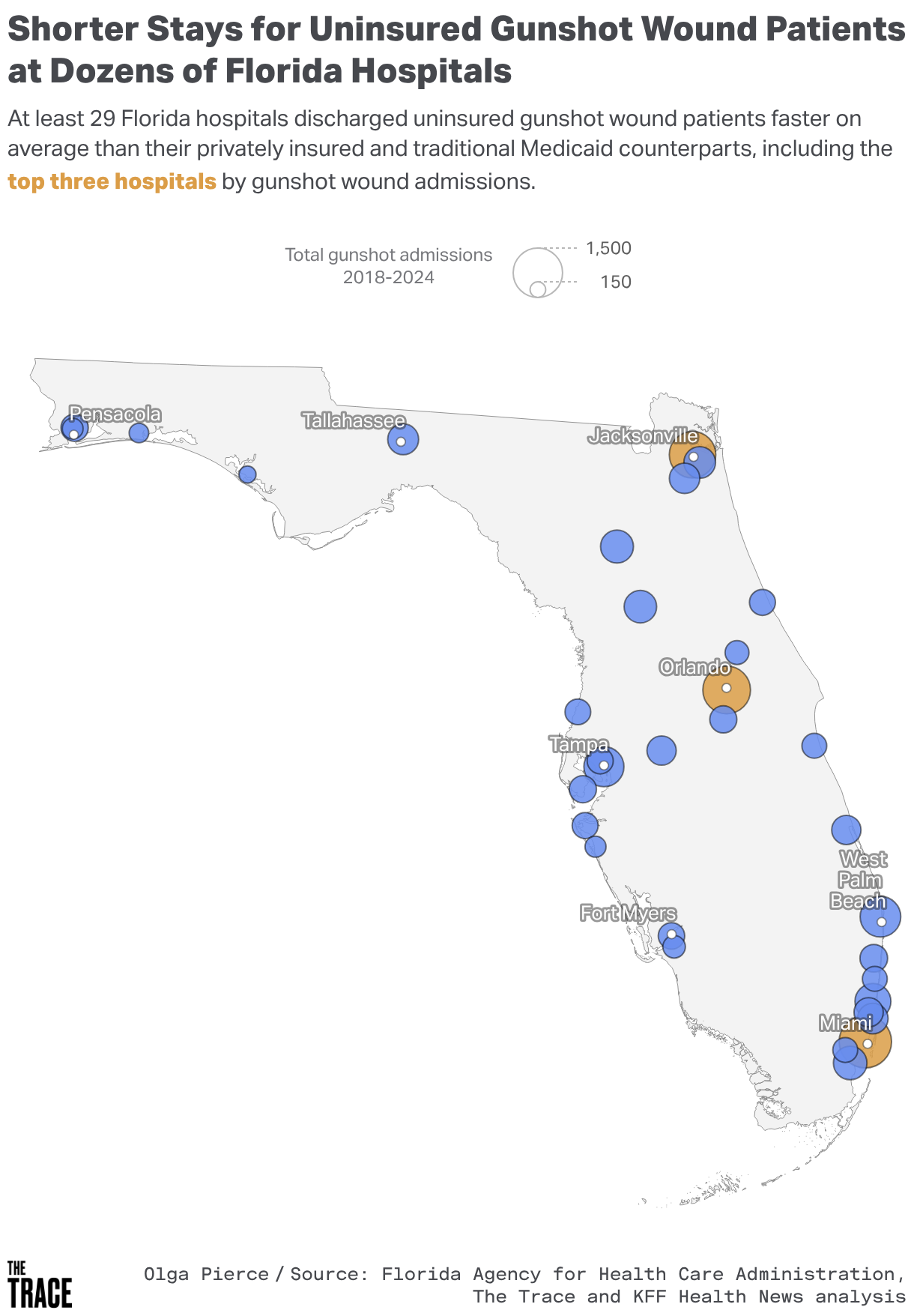
When uninsured patients arrive at hospitals in Florida with gunshot wounds, on average they spend significantly fewer days in the hospital — in some cases half the time — than those with health insurance, according to the data analysis.
Among the most severely injured patients, the uninsured stayed three fewer days in the hospital on average than their counterparts with insurance.
The data was obtained exclusively for this reporting on gun violence hospitalizations in the state, aided by Florida state law.
The newsrooms spent more than a year analyzing the records, which did not identify patients. The data contained patients’ insurance status, their residential ZIP code, their race, and other demographic info. Reporters reviewed academic studies and government documents and interviewed health policy experts, doctors, activists, and victims of gun violence or their relatives.
The results are a first-of-its-kind look at what happens to the insured and the uninsured who are shot and admitted to the hospital for treatment.
Across Florida, the analysis of hospital billing data from 2018 to 2024 obtained from the Florida Agency for Health Care Administration shows:
- Uninsured patients make up a quarter of the more than 20,000 gunshot wound hospitalizations identified, making them the largest single group treated for firearm injuries.
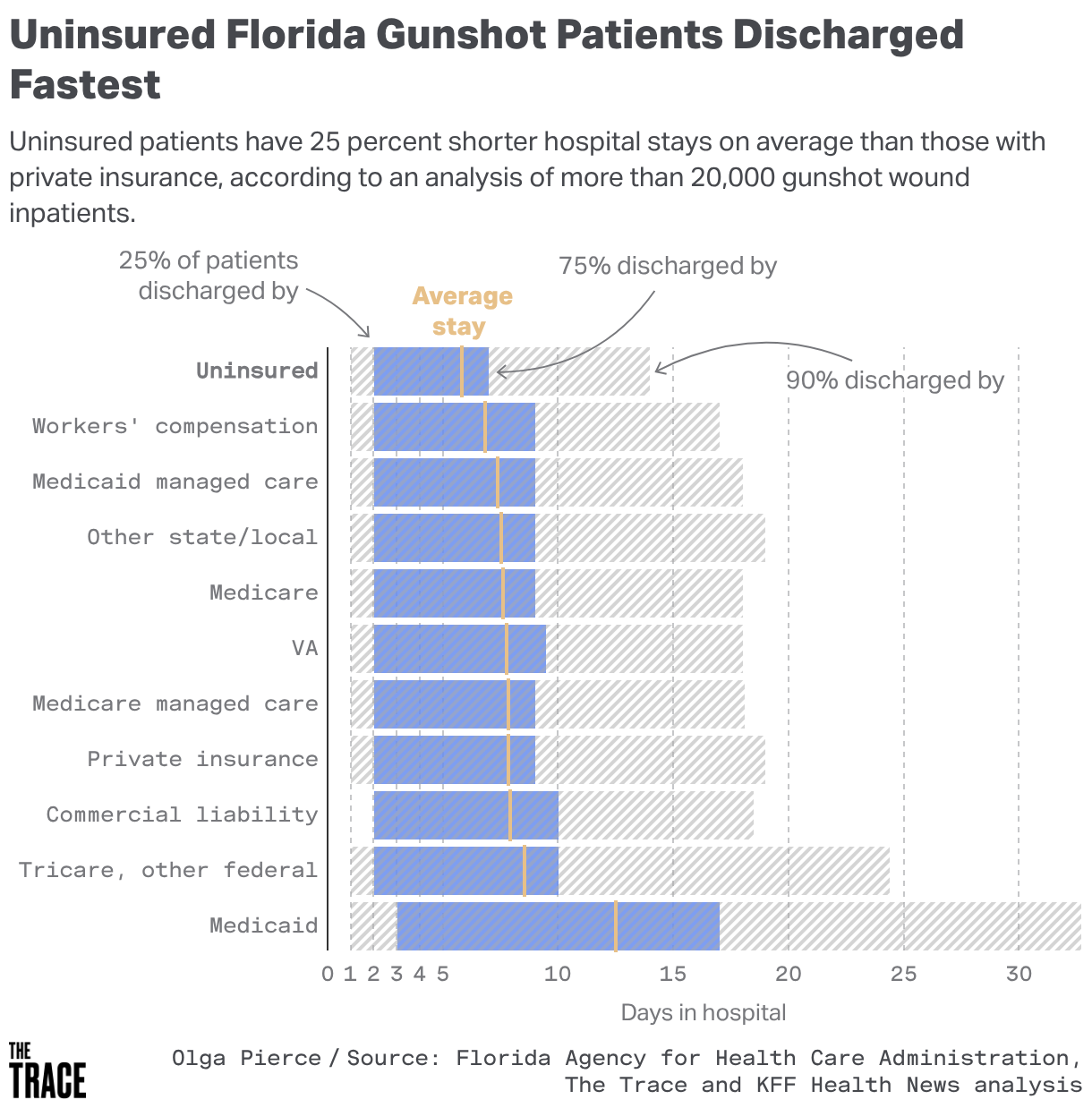
- Uninsured gunshot victims had hospital stays of about six days on average, only three-quarters of the time spent by patients with private insurance and less than half the average stay for patients on traditional Medicaid, the public health insurance program for poor and disabled people.
- The gap in hospital care persisted regardless of hospital size, location, or ownership type, including at facilities that receive taxpayer money with a mandate to treat all patients regardless of their ability to pay.
- Of the gunshot wound patients, nearly half were Black, making the group highly overrepresented. About a quarter of nonwhite patients were uninsured, versus fewer than a fifth of white patients.
The inequality echoes a long history of discrimination in U.S. healthcare against Black and Latino patients, groups that suffer disproportionately from firearm violence and a lack of health insurance.
The U.S. has more gun violence deaths than other wealthy nations, and no group suffers more than Black Americans like Bates. Black people are far more likely to become victims of a firearm homicide than white people, according to the Johns Hopkins Bloomberg School of Public Health.

Patient outreach workers say hospital personnel might perceive gunshot victims as gang members or troublemakers who deserve blame for getting shot. One study found rehab centers refuse to admit gunshot victims more often than other patients, and some medical records from hospitals were littered with racist or insensitive descriptions of patients and their behavior.
The damage can be lasting: Patients who leave the hospital too soon after a traumatic injury have a higher risk of serious complications, including infection, hemorrhage, nerve damage, and death, especially if wounds — and mental health concerns — are left untreated.
Arch Mainous, a University of Florida professor and vice chair for research in community health and family medicine, said there’s evidence that financial incentives drive care — for patients and for hospitals.
Regardless of how often the care team is told to follow quality protocols, Mainous said, “ultimately there’s a business aspect to it, whether the physician is thinking about it or not, whether the nurses think about it or not. But somebody is.”
The Florida data findings come at a time when Republican Gov. Ron DeSantis and state lawmakers have pushed to make guns cheaper and more widely available, despite a 19% increase in gun deaths in the state from 2014 to 2023, and when President Donald Trump’s administration has rolled back legislation from the Joe Biden presidency to curb gun violence and pushed millions of Americans off health insurance.

Florida law allows eligible residents to carry a concealed firearm and to openly carry a firearm without a state-issued license. State law also prevents cities and counties from enacting stricter gun control measures.
In early June, Florida Attorney General James Uthmeier asked a federal judge to strike down the state’s three-day waiting period for receiving a purchased gun, arguing it is unconstitutional. Uthmeier’s request is part of a proposed settlement of a lawsuit brought by the National Rifle Association.
KFF Health News and The Trace requested to speak with administrators at nine of Florida’s large hospital systems to ask why the disparities exist. None agreed to an interview.
Sarah Cannon, communications director at Tallahassee Memorial HealthCare, would not agree to an interview or address Bates’ account of her care for gunshot injuries.
“Clinical decisions, including acute medical intervention, readiness for discharge, and post-acute care needs, are guided by the patient’s condition and response to treatment,” she said in an email.
Cannon said the hospital offers support to patients after discharge, including from social workers who coordinate care and access to services including post-acute care placement, home healthcare, and primary care or specialty follow-up.
Bates said she had to coordinate her own care after being released from the hospital. She said nobody called to schedule a follow-up test of her leg’s muscle function, and her medical records show she did not receive one.
“If I had had insurance,” she said, “they would have definitely kept me there for at least another week to work with me on my standing and walking.”


‘It’s a Business’
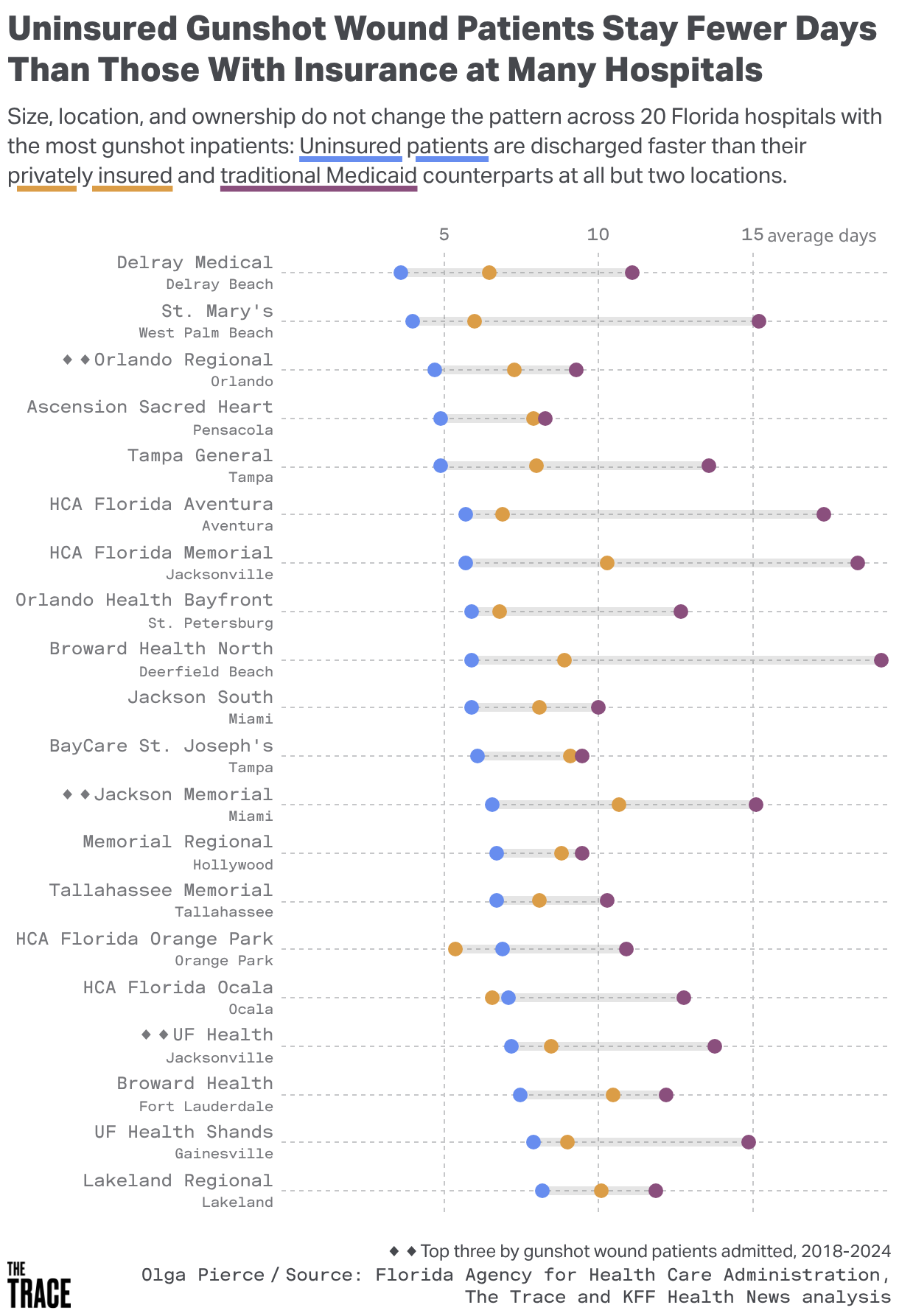
Some of Florida’s largest hospitals showed huge differences in length of stay for gun injuries, the KFF Health News-Trace analysis showed. In Miami at Jackson Memorial, the average number of days in the hospital for uninsured patients was 6.6; for those with private insurance, it was 10.7; and for those on traditional Medicaid, it was 15.4. Jackson Memorial did not respond to requests for comment.
Tampa General Hospital reported 4.9 days for uninsured patients, 8 days for those with private insurance, and 13.6 days for Medicaid patients. “To suggest that care decisions for trauma-related patients, and in this case, gun shot victims, are influenced by insurance status is not only absurd, it’s inaccurate,” Amanda Bevis, a hospital spokesperson, said in a written statement. “At Tampa General, every patient is treated equally, based on clinical need and urgency, not insurance coverage.”
And at UF Health Jacksonville, it was 7.2 days for the uninsured, 8.5 days for the privately insured, and 13.8 days for patients on traditional Medicaid. UF Health declined to comment.
Broward Health in Fort Lauderdale reported 7.5 days for uninsured patients, 10.5 days for privately insured patients, and 12.2 days for those on traditional Medicaid. “Insurance status does not impact treatment plans for patients,” Jennifer Smith, a Broward Health spokesperson, said in an email. “Our physicians always proceed in the best interest of the patient regardless of reimbursement or what length of stay may be required.”
Memorial Regional Hospital in Hollywood reported 6.7 days for uninsured patients, 8.8 days for privately insured patients, and 9.5 days for those on traditional Medicaid. Tania Ordaz, a hospital spokesperson, said in an email that she disagreed with the findings: “Treatment decisions are based on the patient’s clinical condition and what is necessary to ensure a safe and appropriate transition of care, not on the patient’s insurance status.”
Trauma surgeons and academics said the Florida data aligns with research nationwide on where gun violence occurs and who’s most affected. Some said they fear the differences contribute to long-standing disparities in America’s healthcare system along the lines of race and class.
The Florida hospital data showed gunshot injuries are concentrated in a handful of ZIP codes marked by poverty, disinvestment, redlining, and other injustices stemming from racial discrimination.
“Why would people without insurance be discharged earlier?” Mainous said. “Because they’re in better health? I think we’ve got a lot of data that would suggest that’s not true.”
Once they leave the hospital, people with commercial insurance or traditional Medicaid are more than twice as likely to receive follow-up care from another provider — such as a rehab center or home health service — as uninsured patients.
Those patients are staying longer, in part, because hospital case managers coordinate their transfers to other facilities, which can be time-consuming and take days.
“You have to go through insurance authorization and approval,” said Rishi Rattan, a trauma surgeon formerly at Jackson Memorial in Miami who now practices in Oregon. He said patients with private insurance might have access to rehab, preventive care, and training for both the patient and their caregiver to “help them transition to a completely new phase of life.”
For patients without insurance, he said, “sometimes our hands are a little bit tied.”
“The hospital is telling us that this patient has to leave the hospital because they’re medically ready,” he said, “and so I guess we’re discharging them to their car or to their tent, and it doesn’t feel right, but I think that would probably explain some of the differences” in length of stay.
Julie Valenzuela, a trauma surgeon at Jackson Memorial, said hospital staff work to ensure that uninsured patients with long recoveries learn to care for wounds and to enlist family help at home.
Valenzuela said the county-owned hospital does not send uninsured patients home to fend for themselves. She goes into neighborhoods and follows up with patients as part of a Miami-Dade County violence intervention program, whose social workers help them access food, employment, and more to heal and feel safe.
“We know that full recovery is beyond just the hospital and even the rehab centers, even the best ones,” Valenzuela said, pointing to housing and navigating the healthcare system as factors.
Wayne Rawlins runs the Miami-Dade program, which connects victims of gun violence with social workers who visit bedside at the hospital and an intensive care unit-trained nurse who visits at home to provide wound care and other services.
Rawlins said young, Black gunshot patients without health insurance are often at a loss when they leave the hospital about how to schedule a follow-up appointment or manage their mental health.
“After they have been shot and they’re getting out of the hospital and they’re still in crisis,” he said, “their concern is more: How am I going to now pay the rent? How am I going to live? Who’s going to take care of me?”
Often, he said, his uninsured clients leave the hospital before they are ready.
“That’s the reality of it: It’s a business,” he said. “It’s like a hotel. You know, checkout time: You got to go. We got to make room for someone, for a next customer.”
How Long Is Long Enough?
Alea Bates said the hospital discharged her with crutches and one prescription: a seven-day supply of the painkiller Percocet.
A family member drove Bates home. She wore a leg brace, with bandages on her back, stomach, hand, forearm, and feet. When she tried to get out of the car, Bates said, her knee gave and she fell.
Surgeons, health policy experts, and researchers say physicians follow evidence-based best practices for treating gunshot wounds and that a shorter hospital stay does not necessarily reflect a lower-level of care.
Elinore Kaufman, an assistant professor of surgery at the University of Pennsylvania who conducts research on violence reduction, offered one explanation.
In a study published in The Journal of Trauma and Acute Care Surgery, Kaufman and colleagues found that patients who were admitted while uninsured but then enrolled in Medicaid during their hospitalization — and who needed ongoing rehabilitative care after discharge — spent more time in the hospital and had higher costs.
“I have personally been in situations where I felt like I did the best I could for a patient, but they would say, ‘You’re kicking me out,’” she said. “Sometimes, what the doctor is telling you doesn’t match what you are feeling in your body.”
But Kaufman said: “I’m not going to tell you hospitals never discriminate. That would not be realistic. I would say it is more indirect.”
Kaufman said she couldn’t judge whether Bates stayed in the hospital long enough because she was not her doctor. Still, she said, Bates “didn’t get what she needed from our healthcare system.”
Unlike many states, Florida excludes most single adults without children, like Bates, from Medicaid eligibility, making it exceedingly uncommon for a Medicaid patient to have been admitted as an uninsured adult.
Gunshot survivors endure bleeding and oozing flesh wounds and pain, and they experience depression and post-traumatic stress disorder. “These experiences are common, but they are not talked about,” Kaufman said. “Mental health is part of the recovery process.”
Recovering the ability to walk or use an arm or a leg after a gunshot wound requires rehab and physical therapy that can be out of financial reach for uninsured patients, said Brian Englum, a pediatric surgeon and an associate professor at the University of Maryland who has found that uninsured patients hospitalized for traumatic injuries have shorter stays than insured patients.
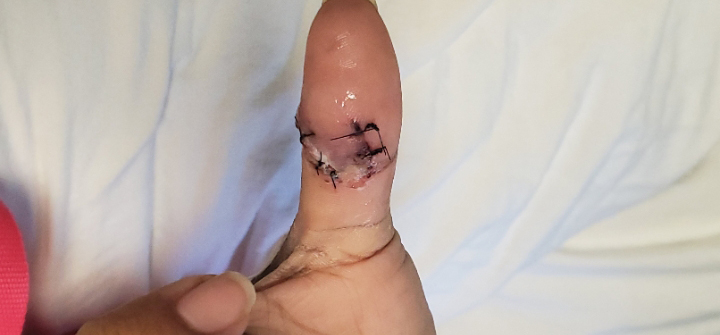
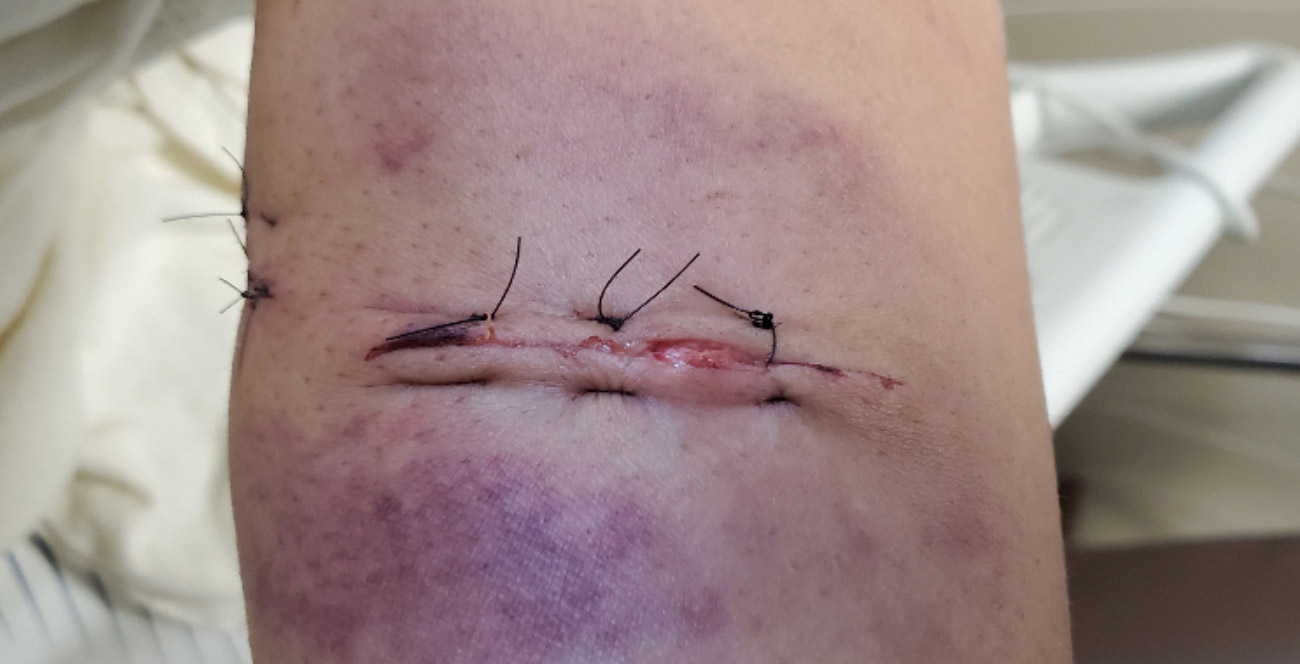
A shorter stay, he said, “suggests that these patients are not getting the same level of care, and that’s going to put them at risk for functional deficits down the road.”
He said it is impossible to arrive at a set number of days that any patient should remain in a hospital. Factors include the severity of their injury, their age, and any other illnesses they have.
“We’re looking for that Goldilocks length of stay,” Englum said, “and unfortunately, it is not perfectly defined for any specific admission, and it’s not perfectly defined for any specific patient.”
‘Oh, Shit. He Shot Me.’