

While being overweight increases the risk of developing lifestyle-related diseases, there is a phenomenon known as the obesity paradox where a decreased risk of death has been seen during cancer therapy. However, that paradox might not be the trend for all cancer therapies, an Osaka Metropolitan University team reports in JAMA Network Open.
Led by graduate student Mr. Yasutaka Ihara and Professor Ayumi Shintani of the Graduate School of Medicine’s Department of Medical Statistics, the team used a Japanese administrative claims database of more than 500,000 lung cancer patients and examined the relation between body mass index (BMI) and the risk of mortality during immunotherapy and conventional chemotherapy.
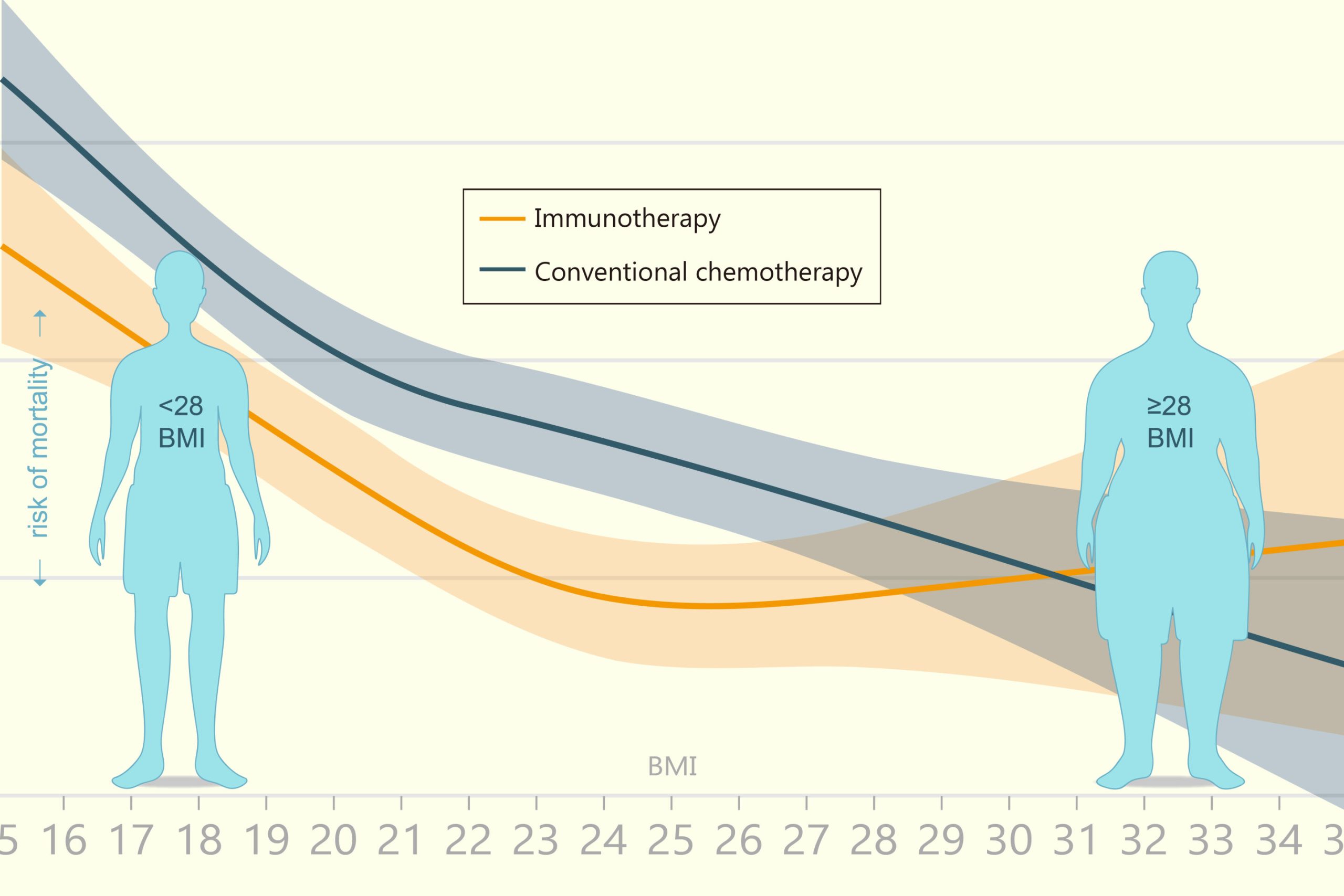
Focusing only on patients with advanced non-small cell lung cancer, the team found that the higher the BMI, the lower the risk of mortality when undergoing both immunotherapy and chemotherapy, though it does a U-turn around a BMI of 24.
Patients with a BMI under 28 showed lower risk of mortality when undergoing immunotherapy compared to conventional chemotherapy, but for those at or over that figure, the risk increases with immunotherapy while it continues to get lower with chemotherapy.
“Immunotherapy might not always be the optimal treatment method for obese patients with advanced non-small cell lung cancer, so the use of conventional chemotherapy should also be considered,” Mr. Ihara stated.
“In addition to BMI, age, hormones, and gut microbiota have been reported as factors that influence the effectiveness of immunotherapy. Evaluation of whether immunotherapy or conventional chemotherapy improves survival in the presence of these factors is expected to contribute to the development of precision medicine.”
More information:
Yasutaka Ihara et al, Immunotherapy and Overall Survival Among Patients With Advanced Non–Small Cell Lung Cancer and Obesity, JAMA Network Open (2024). DOI: 10.1001/jamanetworkopen.2024.25363
Citation:
BMI’s relation to cancer therapy mortality risks not so straightforward, study finds (2024, September 12)
retrieved 13 September 2024
from https://medicalxpress.com/news/2024-09-bmi-cancer-therapy-mortality-straightforward.html
This document is subject to copyright. Apart from any fair dealing for the purpose of private study or research, no
part may be reproduced without the written permission. The content is provided for information purposes only.

