
Weill Cornell Medicine investigators have determined how a molecule within cells can help tune the eyes’ sensitivity to light. The study identified the molecule’s binding site on a protein in retinal cells, which should enable the development of drugs that target the site to treat related eye diseases.
The study, published Sept. 3 in Nature Communications, examined a molecule known as PIP2 (PI(4,5)P2). This phospholipid is found in the membranes of most human cells and has a wide variety of signaling and regulatory functions. Prior research suggests that PIP2 can help tune the sensitivity of light-sensing “rod” cells in the retina by inhibiting the activation of a key ion channel called a CNG channel. But how PIP2 may do this has been unclear. PIP2 appears to be present at very low concentrations in rod-cell membranes, making it hard to measure and even harder to manipulate experimentally.
Pinpointing PIP2’s grip on channels
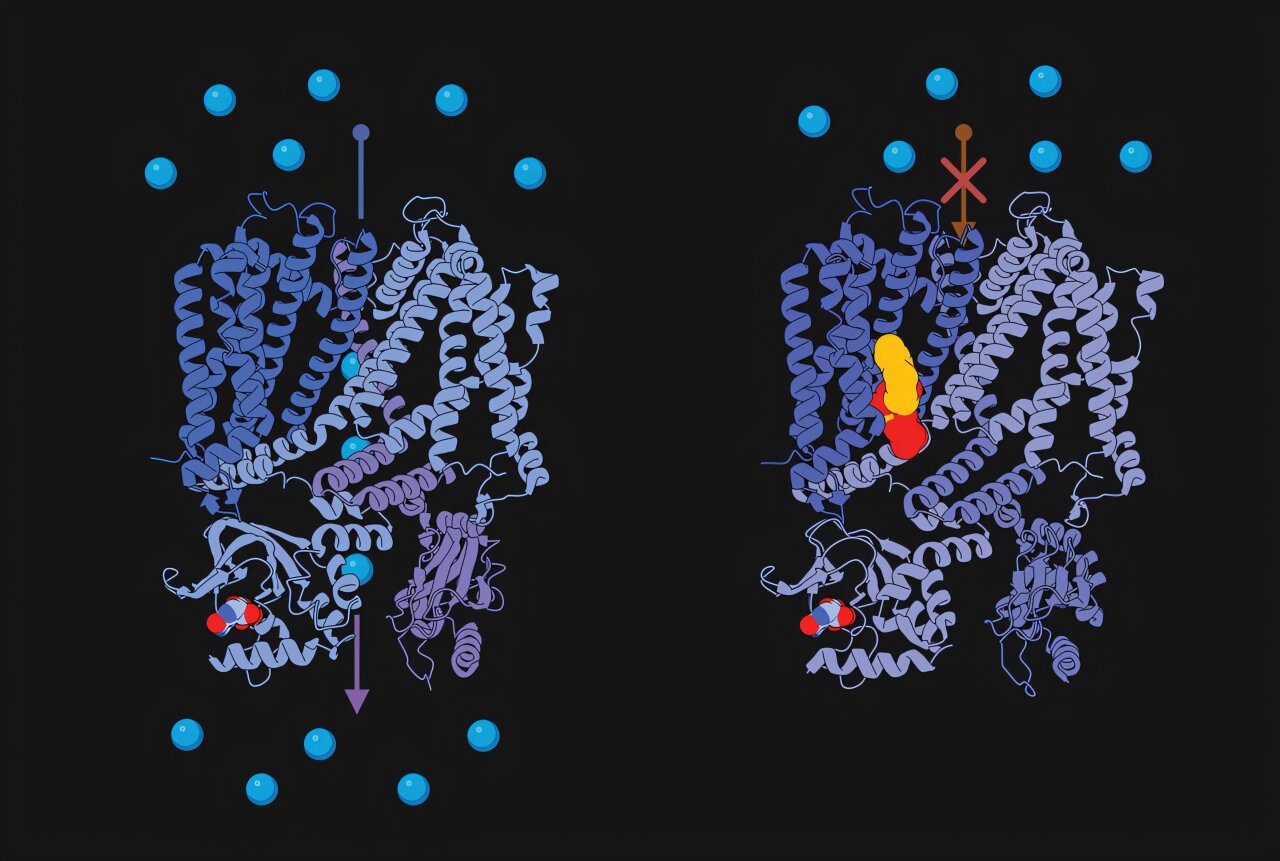
The researchers used model membranes containing CNG channels and well-defined PIP2 concentrations, along with high-resolution imaging techniques, to determine precisely how and where PIP2 binds to CNG channels to inhibit their activity. The results also showed that the very low concentrations of PIP2 seen in rod cells are sufficient to inhibit the channel and potentially help regulate vision.
“These findings establish a framework for understanding how lipids such as PIP2 regulate ion channel activity, and reveal the specific site where a drug could target CNG channels to inhibit their activity,” said senior study author Dr. Crina Nimigean, Distinguished Professor of Anesthesiology Research II and a professor of biochemistry and biophysics in anesthesiology at Weill Cornell Medicine.
Regulators of light sensitivity in the retina underlie the remarkable ability of animal vision to work across a wide range of light levels—considerably wider, for example, than that of film or the semiconductor-based light sensors on modern digital cameras. PIP2’s inhibition of CNG channels in rod cells may be part of the regulatory system that helps maintain optimal vision when rod cells are particularly important: in low light and at the edges of the visual field.

From light sensitivity to treatment
“We think that PIP2’s regulation of CNG channels is part of a natural process of tuning light sensitivity in these cells,” said first study author Dr. Taehyun Park, a postdoctoral fellow in the Department of Anesthesiology.
Understanding how PIP2 inhibits CNG channels also has potential clinical importance. Some forms of retinal degeneration and vision loss are caused by defective CNG channels that end up killing rod cells. In principle, a drug targeting PIP2’s binding site on CNG channels could repair the defective phenotype and ameliorate such conditions. But the structural details of that binding site and PIP2’s inhibitory effect have been unclear.
Low doses hold channels closed
The scientists crafted cell-membrane-like lipid structures with CNG channels and different concentrations of PIP2. They confirmed that PIP2 effectively keeps CNG channels closed even at very low concentrations. Cryogenic electron microscopy also revealed precisely how PIP2 molecules bind to these channels and hold them in a closed state.
Overall, the results offer the first clear and convincing picture of how PIP2 regulates rod-cell CNG channels, the researchers said.
Nimigean’s lab is now following up by studying lipid regulators that help tune vision by activating CNG channels instead of inhibiting them. Their model-membrane approach, which allows precise control of any lipid constituent, also should enable progress in many other research directions, Nimigean said.
Publication details
Taehyun Park et al, PIP2 binding at allosteric site blocks activation in human rod CNG channels, Nature Communications (2026). DOI: 10.1038/s41467-026-77432-0
Journal information:
Nature Communications
Key medical concepts
Clinical categories


Citation:
How a membrane lipid tunes the eye’s response to light (2026, September 24)
retrieved 16 October 2026
from https://medicalxpress.com/news/2026-09-membrane-lipid-tunes-eye-response.html
This document is subject to copyright. Apart from any fair dealing for the purpose of private study or research, no
part may be reproduced without the written permission. The content is provided for information purposes only.