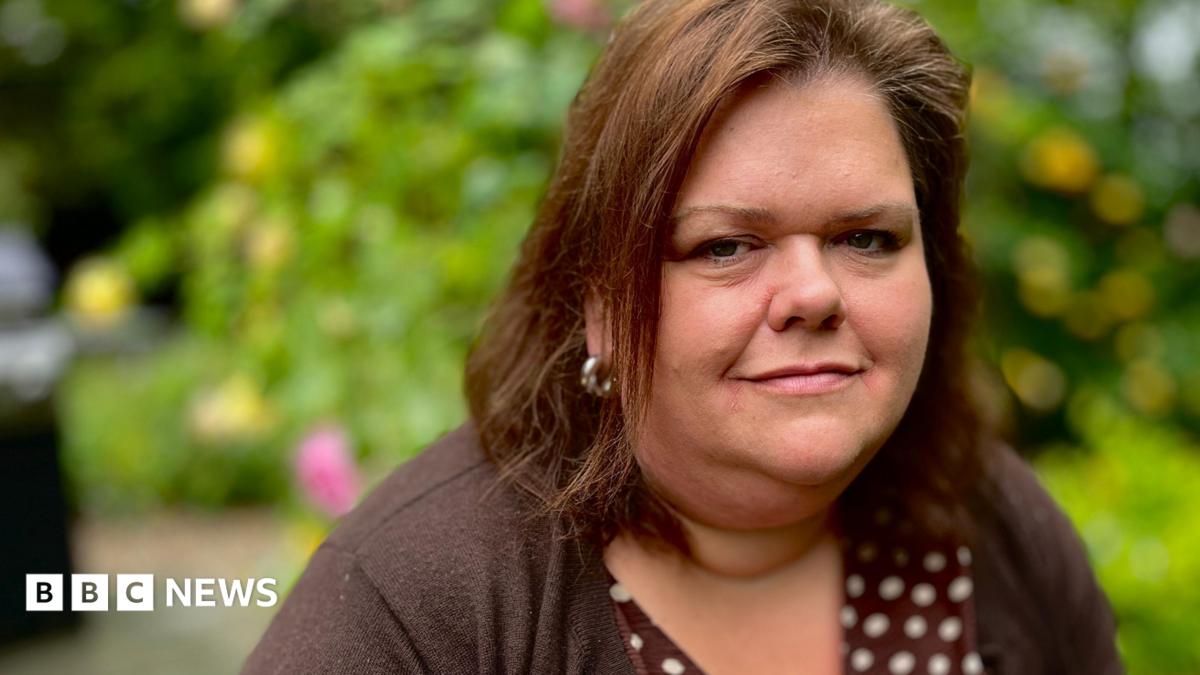
Caroline has type 2 diabetes and a history of infections but says the speed of this one was “just phenomenal”.
“I’ve had illnesses before but with all of them I felt in control,” she says.
“With this, I didn’t.”
In April 2021, during the Covid pandemic, her condition rapidly worsened.
What she initially thought was a small boil began to “track” up her leg, feeling like a “hardened tube”.
At Addenbrooke’s Hospital, Cambridge, a consultant told her she needed immediate surgery and multiple skin grafts and could need to spend up to a year in hospital.
“My response was, ‘No, no, no – I’ve got babies at home,'” she says.
But she was told going home was not an option.
“She said ‘If you don’t do this, you’ll be dead by morning,'” she recalls, adding that the consultant “held my hand and I shed some tears”.
In what she describes as a “terrifying” operation, surgeons removed a large part of her leg to stop the infection spreading.
Later, when she saw images of the damage, she says she could “only describe it as looking like roadkill”.
But doctors were ultimately able to save her leg – something she calls “astounding”.
Caroline spent two weeks in intensive care in a coma, during which time she says her body went into “survival mode” and multiple organs began to fail.