

In 2013, a scientist at Abbott Laboratories saw study results with potentially big implications for the company’s profits and the lives of some of the world’s most fragile people: preterm infants.
The upshot, she wrote in an email: Babies fed rival Mead Johnson Nutrition’s acidified liquid human milk fortifier — a nutritional supplement used in neonatal intensive care units — developed certain complications at higher rates than those given an Abbott fortifier, a researcher at the University of Nebraska had found.
At least one of those complications can be deadly.
The Abbott scientist, Bridget Barrett-Reis, described the results in the email to colleagues, using two exclamation points. Then she proposed that Abbott test the Mead Johnson fortifier, acidified for sterilization, against another Abbott product.
The clinical trial among preterm infants that Abbott subsequently sponsored, known as AL16, is a case study of corporate warfare in the high-stakes business of infant nutrition, wherein preemies have been coveted like commodities; their anxious, vulnerable parents have been — whether they know it or not — targets of calculated commercial pursuit; and scientific research has been used as a marketing tool.
In hospitals around the country, dozens of babies born an average of 11 weeks early were fed Mead Johnson’s fortifier. Dozens of others were fed an Abbott fortifier that wasn’t acidified.
The clinical trial became a boon for Abbott, which publicized the results to wrest market share from Mead Johnson. But for some of the babies enrolled, it didn’t turn out so well, a KFF Health News investigation found.
Far more infants given Mead Johnson’s product developed a buildup of acid in the blood called metabolic acidosis than those fed Abbott’s product — 19 versus four, according to results published in the journal PharmacoEconomics.
Two outside doctors monitoring infants in the study became so alarmed that they refused to enroll any more babies, according to an April 2016 email one of them sent to Abbott.
In a related email to Abbott, neonatologist Robert White of Memorial Hospital in South Bend, Indiana, and Pediatrix Medical Group — an investigator in the study — explained his concerns.
“We had another SAE” — serious adverse event — “today in which a child developed profound metabolic acidosis while on the study fortifier,” White wrote. The severity was “unlike what we would see in most children with these issues.”
A manager at Abbott replied that the company was “taking your concerns very seriously.”
The study continued for almost a year.
At least some of the consent forms used to inform parents about risks did not mention metabolic acidosis or the often-fatal necrotizing enterocolitis, another condition identified in the 2013 email that led to the study.
In a November response to questions for this article, Abbott spokesperson Scott Stoffel said the clinical trial “was safe and ethical” and that the fortifiers it compared were “on the market and widely used.”
The study was “led by 20 non-Abbott investigators,” Stoffel said.
According to a federal website, Abbott’s Barrett-Reis chaired the study.
Stoffel added that the study was approved “by 14 independent safety review boards at hospitals” and “published in a leading peer-reviewed scientific journal.”
“It is reckless and not credible to suggest that these doctors and institutions conducted and then published the results of an unsafe or unethical study,” Stoffel said.
A spokesperson for Mead Johnson, Jennifer O’Neill, did not comment on Abbott’s clinical trial but said in a November statement to KFF Health News that existing studies “cannot responsibly support” any connection between the acidified fortifier and conditions such as necrotizing enterocolitis or metabolic acidosis.
Mead Johnson executive Cindy Hasseberg argued in a deposition that Abbott waged a “smear campaign” against the acidified fortifier that was “very hard to come back from.”
In 2024, Mead Johnson discontinued the product.
Winning the ‘Hospital War’
Behind their warm-and-fuzzy marketing, industry giants Abbott, maker of Similac products, and Mead Johnson, maker of the Enfamil line, have turned neonatal intensive care units into arenas of brutal competition.
This article quotes from and is based largely on records from three lawsuits against formula manufacturers that went to trial in 2024 and are now on appeal. The cases are Watson v. Mead Johnson, Gill v. Abbott Laboratories, and Whitfield v. St. Louis Children’s Hospital. The records include emails, internal presentations, and other company documents used as exhibits in litigation, as well as court transcripts and witness testimony from depositions.
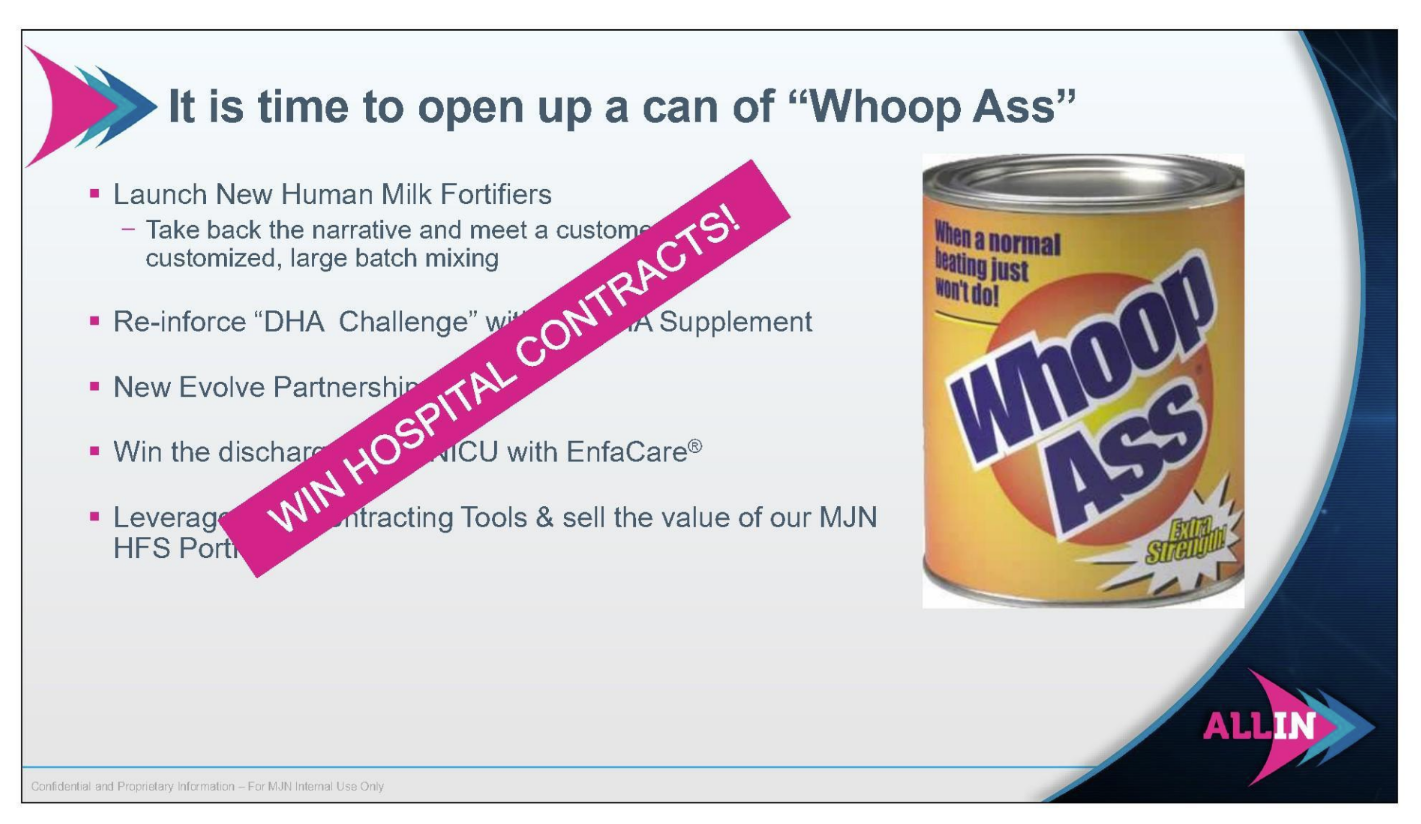
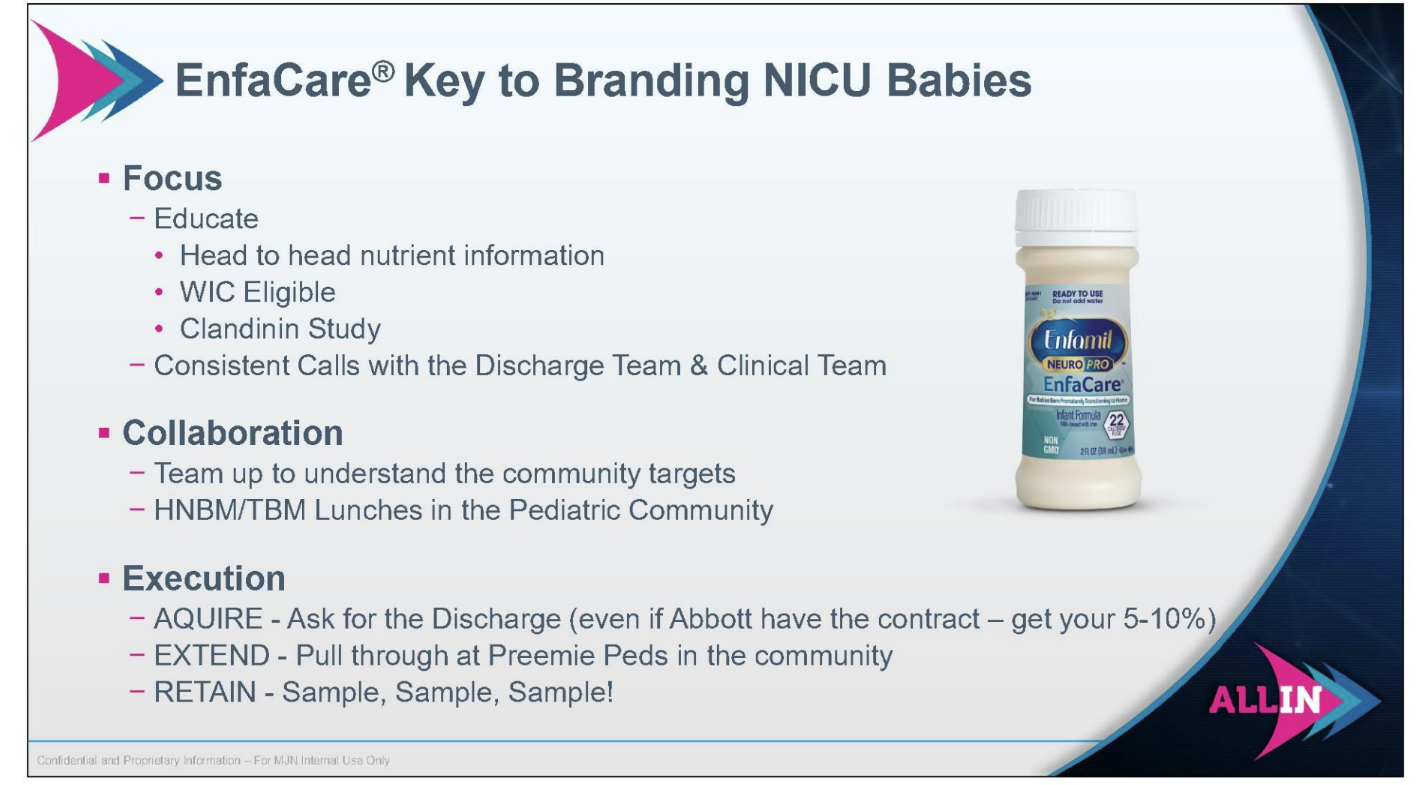
The records provide an inside view of the business of infant formula and fortifier, a nutritional supplement added to a mother’s milk. For example, a Mead Johnson slide deck for a 2020 national sales meeting — later used in the Whitfield trial — outlined a plan for “Branding NICU Babies.”
Urging employees to win more sales from neonatal intensive care units, the document said: “It is time to open up a can of ‘Whoop Ass.’”
In internal documents and other material from litigation reviewed by KFF Health News, formula makers described hospitals as gateways to the much larger retail market because parents are likely to stick with the brand their babies started on. Products used in the NICU help win hospital contracts, and hospital contracts help establish brand loyalty, according to court records.
Manufacturers vie for contracts that can be “exclusive” or nearly so, according to records from the litigation, including company documents and testimony by people who have worked in management for the companies.
An undated Abbott presentation used in the Gill case, apparently referring to inroads with hospitals in its rivalry with Mead Johnson, boasted of “MJ Strongholds Broken!”
It saluted two employees who “Own 27K Babies Exclusively,” and said another “Stole 600 formula feeders from MJ.”
Still others were praised for “Playing in Mom’s mailbox” or “kicking … and ‘taking names.’”
In July 2024, Abbott CEO Robert Ford said in a conference call for investors that formula and fortifier for preterm infants generated total annual revenue of about $9 million — a small portion of Abbott’s total sales of $42 billion in 2024 and its $2.2 billion of sales in the United States from pediatric nutritional products.
Industry documents cited in litigation provide a different perspective.
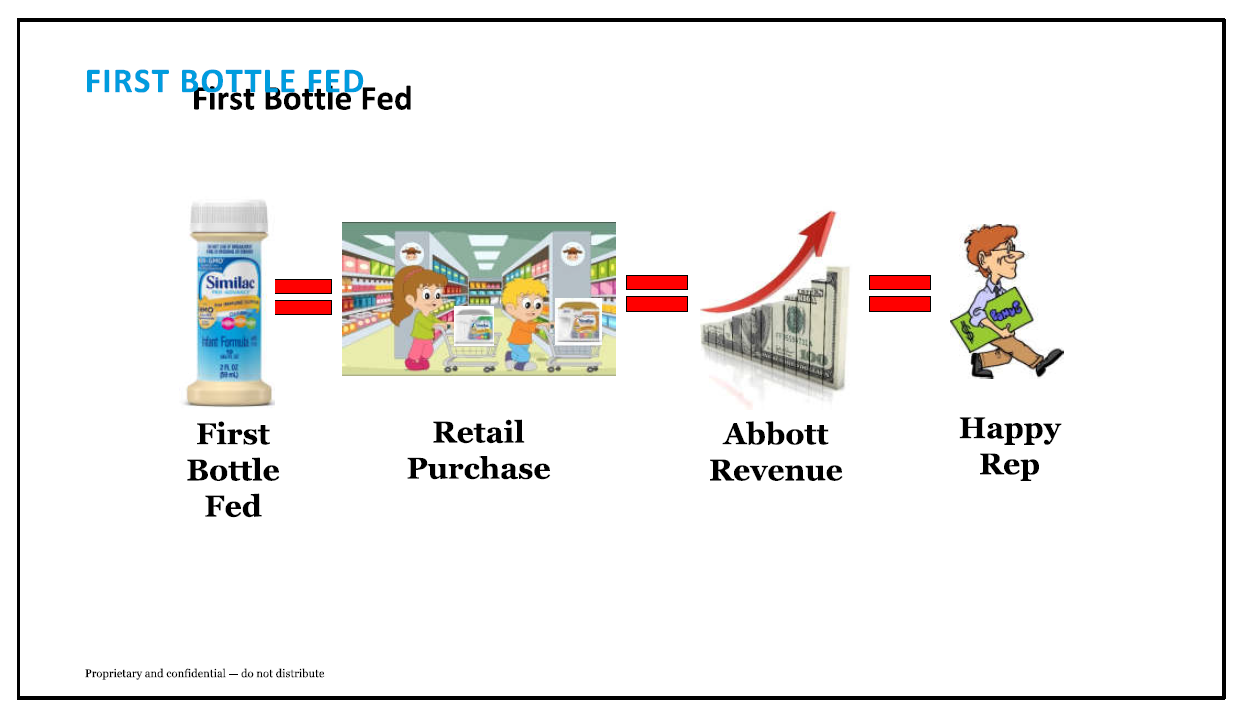
“‘First Bottle Fed’ drives our business,” stated an Abbott training presentation from about a decade ago used in the Gill and Whitfield trials.
That described a baby’s first formula feeding in the hospital, the document said. Over 74% of the time, an infant fed formula in the hospital stays on that brand at home, the document said.
Abbott’s goal was that the first-bottle-fed strategy would help generate more than $1.5 billion in sales, the document showed. A staff training slide displayed during the Whitfield trial showed how that momentum could pay off in bonuses for Abbott sales representatives, leading to a “Happy Rep.”
Mead Johnson has espoused a similar strategy.
The company rolled out a “Flip & Win” incentive plan with cash rewards for flipping hospitals from Abbott, according to a 2019 document marked for internal use by Mead Johnson and its parent company, England-based Reckitt Benckiser Group, and admitted into evidence in the Watson case.
“Winning in the NICU is critical to contract gains and acquisition,” stated a company plan for 2022 that was cited in the Whitfield case.
One Abbott document shown in the Whitfield trial said more than half of first feedings happen at night, adding, “Nighttime is the right time to drive your business.”
A “Mead Johnson University” training document described a scenario in which a sales rep overhears patient information in a NICU and encouraged the rep to promote the company’s products. The document, titled “Advanced NICU Skills,” was admitted as evidence in the Watson case.
“[Y]ou are walking back into your most important NICU,” it said. “You overhear the HCP’s” — health care providers, apparently — “stating all of the notes,” it said. “There may be some information that may help you to position your products as a resource for this patient and to handle any objections that the HCP may present you with.”
To win parents’ business, companies have supplied formula to hospitals free or at a loss, court records show. That has resulted in such curiosities as a Mead Johnson “purchasing agreement” cited in the Watson case, listing the price for product after product as “no charge.”
In a 2017 strategy document prepared for Mead Johnson, a consulting firm laid out a plan “to win hospital war.”
Why focus on hospitals? “INFLECTION POINT FOR VULNERABLE MOMS,” it explained.
The document was displayed in the Whitfield case.
In the market for preterm nutrition, Abbott and Mead Johnson compete with each other, not against the use of human milk, the companies told KFF Health News.
“Thus, references in documents about wanting to ‘win’ or ‘own’ the NICU refer to out-performing Mead Johnson by offering the highest-quality products,” Abbott’s Stoffel said in February.
Asked specific questions about business strategies and internal documents, Mead Johnson’s O’Neill said the company was “concerned that you are presenting a misleading and incomplete picture.”
Mead Johnson’s products “are safe, effective, and recommended by neonatologists when clinically appropriate,” O’Neill added.
On the Defensive
In courthouses around the country, Abbott and Mead Johnson are on the defensive — and have been for years.
In hundreds of lawsuits, parents of sickened or deceased preterm infants have alleged that formula designed for preemies has caused necrotizing enterocolitis, or NEC, a devastating condition in which immature intestinal tissue can become infected and die, spreading infection through the body.
Lawsuits also accuse the manufacturers of failing to warn parents of the risk.
One of the cases on which this article is based, Watson v. Mead Johnson, resulted in a $60 million judgment against Mead Johnson. Another, Gill v. Abbott Laboratories, et al., resulted in a $495 million judgment against Abbott. The third, Whitfield v. St. Louis Children’s Hospital, et al., resulted in a jury verdict in favor of Abbott and Mead Johnson, but the judge found errors and misconduct on the part of defense counsel, faulted his own performance, and granted the plaintiff a new trial.
The cases have involved children like Robynn Davis, who was born at 26 weeks, lost 75% to 80% of her intestine to NEC, suffered brain damage — and, at almost 3 years old, couldn’t walk, couldn’t really talk, and was eating through a tube, as Jacob Plattenberger, an attorney representing her, described in court in 2024.
An attorney for Abbott, James Hurst, said in court that Robynn suffered a catastrophic brain injury at birth, 10 days before she received any Abbott formula, and that her NEC resulted not from formula but from many health problems.
In at least three cases, a federal judge has granted summary judgment in favor of Abbott — ruling for the company before the lawsuits even reached trial.
The formula makers have repeatedly denied fault.
Addressing stock analysts in 2024, Abbott’s chief executive denounced as “without merit or scientific support” the theory that preterm infant formula or milk fortifier caused NEC.
In a joint statement issued in 2024, the FDA, the Centers for Disease Control and Prevention, and the National Institutes of Health said there was “no conclusive evidence that preterm infant formula causes NEC.”
Mead Johnson’s O’Neill said the scientific consensus is that there is no established causal link between the use of specialized preterm hospital nutrition products and NEC.
Neonatologists use the products routinely, O’Neill said.
O’Neill cited a statement by the American Academy of Pediatrics saying the causes of NEC “are multifaceted and not completely understood.”
In a legal brief filed with an Illinois appeals court in the Watson case, the company said “the NEC-related risks” of a formula for preterm infants “are the subject of medical debate,” adding that trial evidence “demonstrated, at a minimum, uncertainty as to the magnitude of the risk, as well as the causal role of various feeding options in the development of NEC.”
Manufacturers say formula is needed when mother’s milk or human donor milk isn’t an option. Fortifier, a product tailored to preemies, is meant to augment mother’s milk when babies are born prematurely and a mother’s milk alone doesn’t deliver enough nutrition. The Mead Johnson fortifier used in the head-to-head clinical trial sponsored by Abbott was acidified to prevent bacterial contamination.
In March 2025, Health and Human Services Secretary Robert F. Kennedy Jr. announced that his department, which encompasses the FDA, was undertaking a review of infant formula, dubbed “Operation Stork Speed.” It includes reassessing nutrient requirements and increasing testing for heavy metals and other contaminants, HHS said.
However, FDA oversight of infant formula is limited. The agency doesn’t approve the products or their labeling. Whether to report adverse events — illnesses or deaths potentially related to the products — to the FDA is largely at manufacturers’ discretion.
The business of infant formula further spotlights a central contradiction in the Trump administration’s health policies. When it comes to food and medical products, the administration has criticized industry-funded research as unworthy of trust. Yet under Kennedy, it has disrupted, defunded, or sought to cut government-funded research, which could leave industry-funded research with a larger and more influential role.
It “is entirely appropriate for the Department to scrutinize research design, conflicts of interest, and funding sources, particularly when research is used to inform public policy,” HHS spokesperson Andrew Nixon said.
‘At the Table’
Company emails cited in litigation shed light on the industry’s approach to research.
In a 2015 email, when Mead Johnson was considering supplying some of its formula to a researcher for a study, a company neonatologist expressed concern that the results could be spun to make the preemie product look unsafe.
“However, we are more likely to have control over final language if we provide the small support and are ‘at the table’ with him,” Mead Johnson’s Timothy Cooper added in the email, which was cited in the Watson trial.
In 2017, Abbott exchanged a series of messages with researchers at Johns Hopkins University about a study on how the composition of infant formul