
Many surgeons admit that medical robots can now operate with greater precision than human specialists. However, the complex preparation required for robotic surgery still takes far too long. But a new robotic assistant for eye surgery for age-related macular degeneration (AMD) developed by Prof. Mohammad Ali Nasseri from the Technical University of Munich (TUM) is ready to go in just under five minutes.
Currently, doctors treat AMD by injecting drugs into the side of the eye. The robot is capable of inserting injections into the 200-micrometer-thick retina with an accuracy of just 15 micrometers. This ensures that the active ingredient is delivered precisely to the right place, where it can block a growth factor that would otherwise lead to blindness in those affected.
Currently, nearly 200 million people worldwide suffer from the disease, and by 2040, that number is expected to rise to more than 280 million. People over the age of 60 are particularly affected, with AMD being the cause of blindness in nearly one in ten cases.
Five minutes of preparation time for the robot and the patient
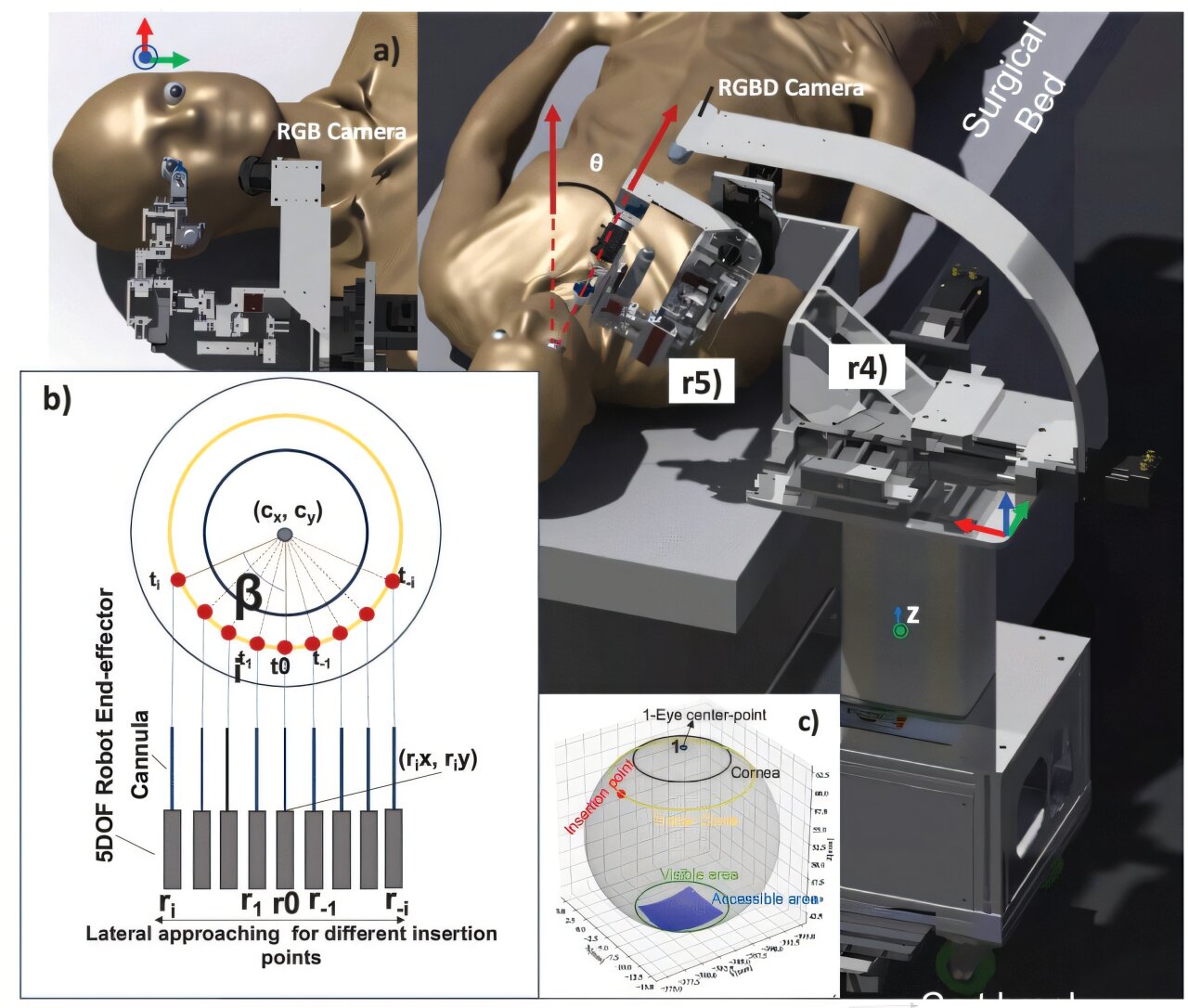
Nasseri conducts research at the Chair of Medical Autonomy and Precision Surgery and is a member of the Munich Institute of Robotics and Machine Intelligence (TUM MIRMI). His team has developed a mobile platform with a turntable and a highly sensitive robotic arm. The sensors automatically locate the eye and iris.
“We have trained the neural networks so that the robot can assume the perfect position for the operation in less than five minutes,” says Nasseri. Typically, preparation for robot-assisted surgery takes up to an hour.
15-micrometer accuracy feasible
The ideal surgical preparation process involves the mobile platform moving up to the treatment bed with centimeter precision, positioning the robotic instruments above the bed with millimeter precision, and ultimately operating with micrometer precision.
“The last step is the biggest challenge,” says Nasseri, who is collaborating with a Japanese manufacturing company on the high-precision “manipulator.”
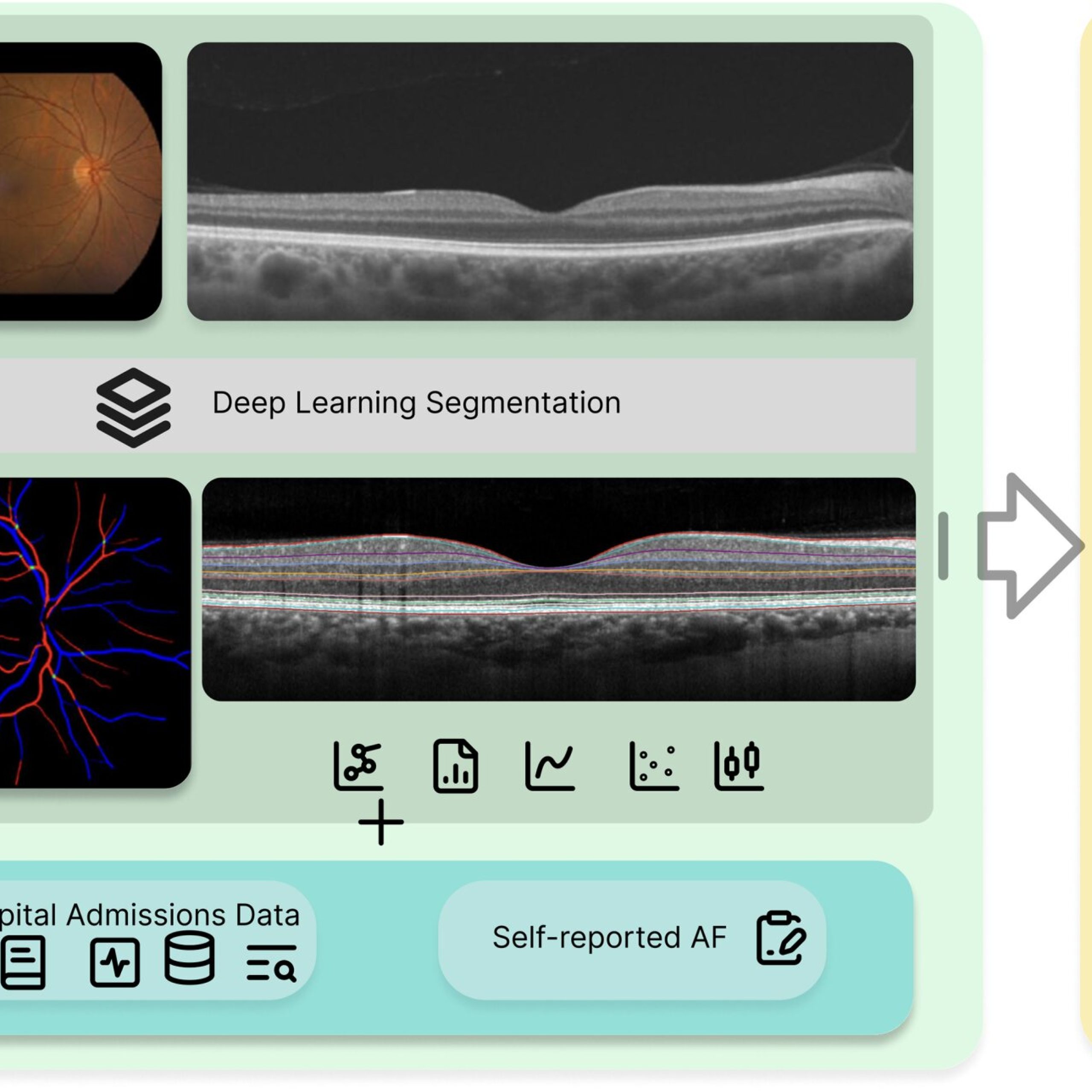
It is capable of placing the syringe with a precision of 15 micrometers. However, despite anesthesia, the eye may move involuntarily during surgery. To detect these slight and slow movements, researchers use an optical coherence tomography (OCT) device, which continuously takes images of the retina.
To replicate and simulate this movement, the researchers had an artificial eye perform sinusoidal movements. The new precision robot is capable of following these movements for a full minute. This allows the drug to be administered with a deviation of 25 micrometers—in other words, 0.025 millimeters.
“That is still perfectly adequate for such applications,” says Prof. Nasseri. The TUM Clinic has played a crucial role in the development of the robot. The director of the Department of Ophthalmology, Prof. Peter Charbel Issa, is confident that it will help to avoid complications such as inflammation, which can occur when administering medication manually.
The research is published in IEEE Access and as part of the 2025 International Symposium on Medical Robotics (ISMR).
It will be some time, however, before the robot actually administers its first injection into a human eye: the next step will be to test it on the eyes of dead pigs, which are very similar in structure to those of humans.
Initial tests on live animals are planned for early 2026, before humans can receive their first injection in clinical trials in a few years.
More information:
Alireza Alikhani et al, PAROS: Multi-Component Robotic System and an Image-Guided Patient Alignment for Robot-Assisted Ophthalmic Surgery, IEEE Access (2025). DOI: 10.1109/access.2025.3564944
Demir Arikan et al, Towards Motion Compensation in Autonomous Robotic Subretinal Injections, 2025 International Symposium on Medical Robotics (ISMR) (2025). DOI: 10.1109/ismr67322.2025.11025990
Citation:
Age-related macular degeneration: Robot delivers ultra-precision injections with rapid setup times (2025, October 22)
retrieved 22 October 2025
from https://medicalxpress.com/news/2025-10-age-macular-degeneration-robot-ultra.html
This document is subject to copyright. Apart from any fair dealing for the purpose of private study or research, no
part may be reproduced without the written permission. The content is provided for information purposes only.