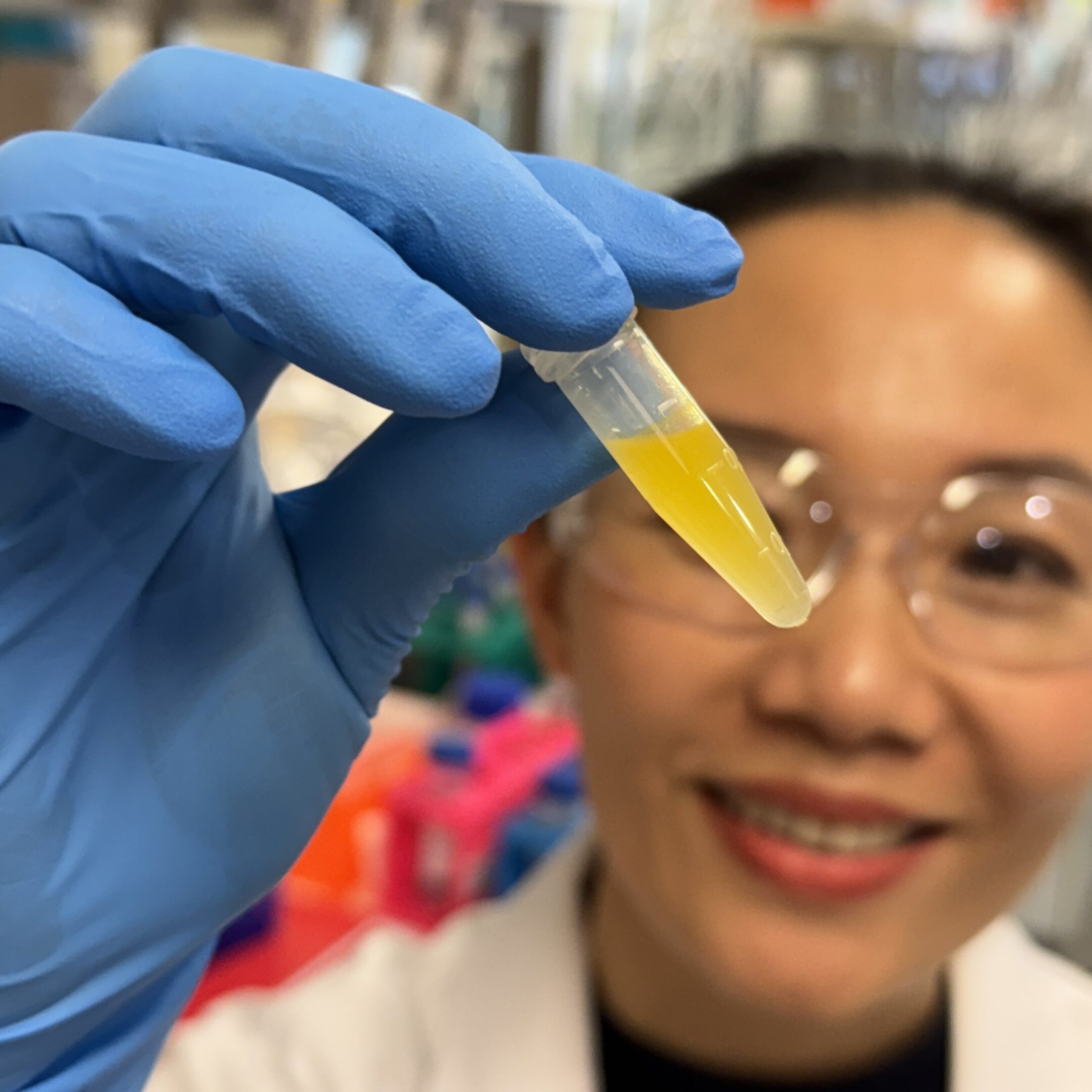

A new eyedrop has shown early success in delivering protective compounds to where they’re needed most in the eye, raising hopes for less invasive treatment of serious vision conditions.
The research led by RMIT University is focused on retinal diseases, especially age-related macular degeneration (AMD). AMD damages the retina, specifically the macula, which can cause blindness and affects hundreds of millions of people globally.
Key risk factors for AMD are age, family history, diet, high blood pressure, obesity, smoking and other lifestyle choices.
In the modern era, we have exposure to excessive high energy blue light from devices such as mobile phones, computer screens and televisions, which may also contribute to eye damage over time.
The team investigated delivering lutein, a protective antioxidant compound found in Gac fruit, to the back of the eye to support retinal health and potentially slow or prevent damage.
In pre-clinical mice studies conducted in collaboration with the Center for Eye Research Australia (CERA), the formula reached the retina at the back of the eye—currently only accessible through injections—and kept the active compound stable for months at room temperature.
The team’s cell culture study demonstrated that lutein delivered using their new formulation protected retinal cells from stress and damage linked to vision loss.
Dr. Dao Nguyen, who co-led the research when she was at RMIT, said the formulation could pave the way for more patient-friendly therapies.
“Frequent eye injections are uncomfortable and can be distressing for patients. If the formulation works, people could use the eyedrop as a preventative measure that could reduce the risk of developing late-stage diseases and the need for injections,” said Nguyen, who is now at Deakin University’s School of Medicine.
“Our eyedrop formula is designed to treat early stages of age-related macular degeneration in a way that’s far easier to use, but it will take further research and clinical trials before it can reach people.”
The eyedrops would not replace injections, Nguyen said.
Team leader Associate Professor Tien Huynh from RMIT’s School of Science said the delivery platform could be adapted to carry different compounds, not just the one tested in this study.
“This is a technology with broad potential. We’ve shown it can protect fragile ingredients and carry them safely to the back of the eye, which has long been a barrier for treatments,” Huynh said.
Professor Charlotte Conn and Dr. Sampa Sarkar, lead researchers on the innovative delivery method, said the RMIT-patented nanotechnology called cubosomes to deliver drugs was showing early promise for this and a range of other drug delivery applications.
“Our cubosome carriers act like tiny shields, keeping the compound safe and releasing it in a controlled way once it’s inside the eye,” said Conn, from RMIT’s School of Science.
Associate Professor Chi Luu, a clinician-scientist at CERA and the University of Melbourne, said the findings were encouraging.
“This kind of approach could transform how we manage age-related macular degeneration. If future trials confirm the safety and effectiveness of the delivery platform, eyedrops could one day be used for treating early stages of AMD and other serious retinal diseases,” Luu said.
The researchers note the work is still at an early stage: the results come from cell and animal studies, and the experiments did not test whether the formulation improved disease outcomes as the mice did not have AMD or any other retinal conditions.
The next step is to work with clinical and industry partners to test the formula further and move it towards human trials.
The research, “Optimizing lutein formulations for targeted ocular drug delivery: in vitro and in vivo insights’, is published in the journal ACS Applied Materials & Interfaces.
Other co-authors on the study were Dr. Thilini Thrimawithana and Professor Terrence Piva.
A recent literature review from the team, led by RMIT Ph.D. scholar Christopher Olowosoke, highlights the promise of plant compounds, including lutein, for protecting eye health.
The research, “Non-invasive pharmacological advances in early retinopathy treatment: bioactive herbal compounds, polymer delivery systems, and computational bioprospecting of functional targets,” is published in the journal Pharmacological Reports.
More information:
Dao Nguyen et al, Optimizing Lutein Formulations for Targeted Ocular Drug Delivery: In Vitro and In Vivo Insights, ACS Applied Materials & Interfaces (2025). DOI: 10.1021/acsami.5c14464
Christopher Busayo Olowosoke et al, Non-invasive pharmacological advances in early retinopathy treatment: bioactive herbal compounds, polymer delivery systems, and computational bioprospecting of functional targets, Pharmacological Reports (2025). DOI: 10.1007/s43440-025-00778-7
Citation:
Experimental eyedrop formula delivers protective compounds for serious vision problems (2025, September 22)
retrieved 22 September 2025
from https://medicalxpress.com/news/2025-09-experimental-eyedrop-formula-compounds-vision.html
This document is subject to copyright. Apart from any fair dealing for the purpose of private study or research, no
part may be reproduced without the written permission. The content is provided for information purposes only.