
Researchers, including those at the University of Tokyo, have made a surprising discovery hiding in people’s mouths: Inocles, giant DNA elements that had previously escaped detection. These appear to play a central role in helping bacteria adapt to the constantly changing environment of the mouth.
The findings, published in the journal Nature Communications, provide fresh insight into how oral bacteria colonize and persist in humans, with potential implications for health, disease and microbiome research.
You might think that modern medical science knows everything there is to know about the human body. But even within the last decade, small, previously unknown organs have been discovered, and there’s one area of human biology that is currently going through a research renaissance, the microbiome.
This includes familiar areas such as the gut microbiome, but also the oral microbiome.
Inspired in part by recent discoveries of extraneous DNA in the microbiome of soil, Project Research Associate Yuya Kiguchi and his team turned their sights to a large set of saliva samples collected by the Yutaka Suzuki Lab of the Graduate School of Frontier Sciences at the University of Tokyo. They wondered if they might find something similar in human saliva.
“We know there are a lot of different kinds of bacteria in the oral microbiome, but many of their functions and means of carrying out those functions are still unknown,” said Kiguchi.
“By exploring this, we discovered Inocles, an example of extrachromosomal DNA—chunks of DNA that exist in cells, in this case bacteria, but outside their main DNA. It’s like finding a book with extra footnotes stapled to it, and we’re just starting to read them to find out what they do.”
Detecting Inocles was not easy, as conventional sequencing methods fragment genetic data, making it impossible to reconstruct large elements.
To overcome this, the team applied advanced long-read sequencing techniques, which can capture much longer stretches of DNA.
A key breakthrough came from co-first author Nagisa Hamamoto, who developed a method called preNuc to selectively remove human DNA from saliva samples, greatly improving the quality of sequencing long sections of other DNA. This allowed the researchers to assemble for the first time complete Inocle genomes, which turned out to be hosted by the bacteria Streptococcus salivarius, though identifying the host itself was a difficult matter.
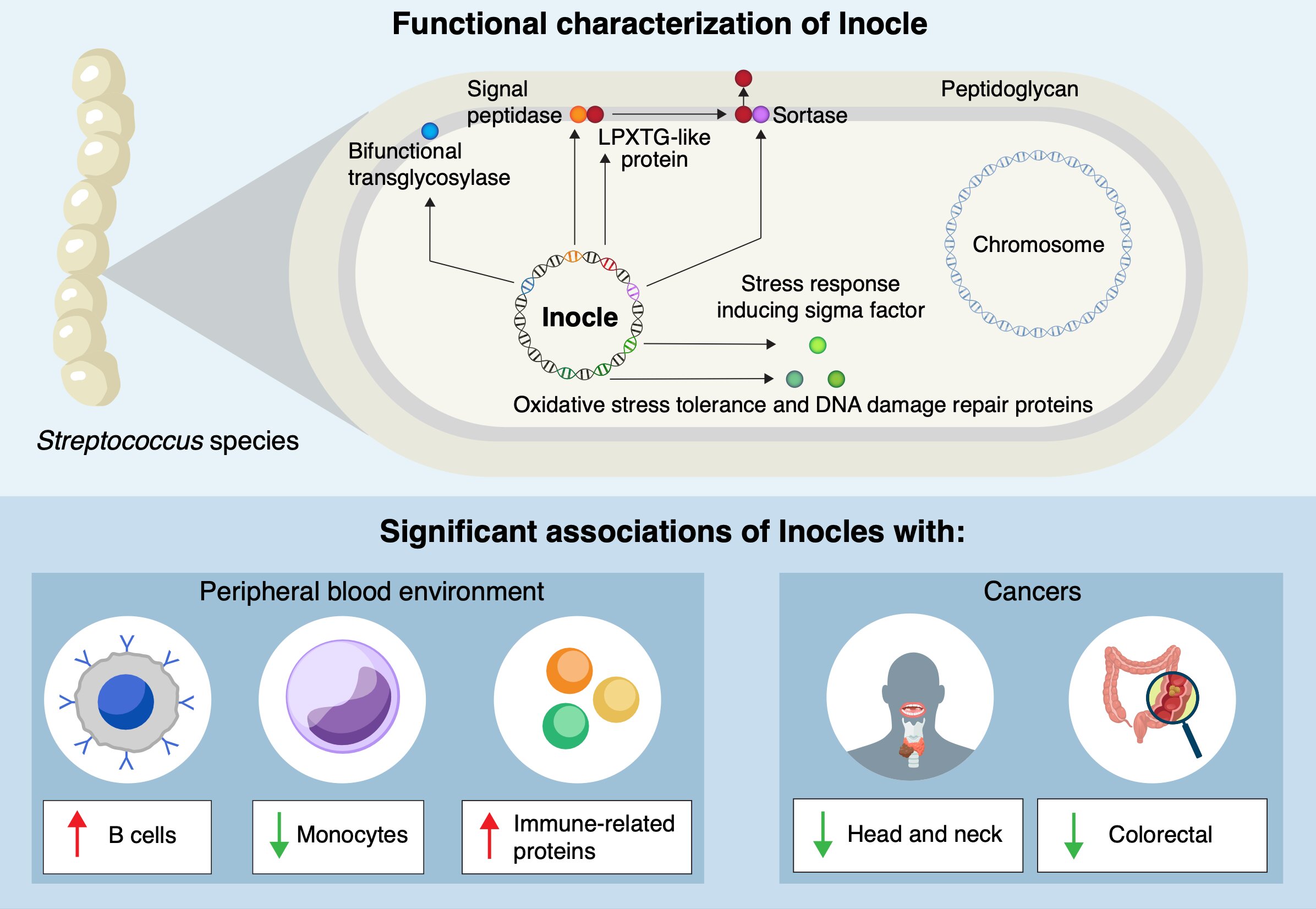
“The average genome size of Inocle is 350 kilobase pairs, a measure of length for genetic sequences, so it is one of the largest extrachromosomal genetic elements in the human microbiome. Plasmids, other forms of extrachromosomal DNA, are at most a few tens of kilobase pairs,” said Kiguchi.
“This long length endows Inocles with genes for various functions, including resistance to oxidative stress, DNA damage repair and cell wall-related genes, possibly involved in adapting to extracellular stress response.”
The team aims to develop stable methods for culturing Inocle containing bacteria. This will allow them to investigate how Inocles function, whether they can spread between individuals, and how they might influence oral health conditions such as cavities and gum disease.
Since many Inocle genes remain uncharacterized, researchers will use a mixture of laboratory experiments and also computational simulations such as AlphaFold to predict and model the roles Inocles may play.
“What’s remarkable is that, given the range of the human population the saliva samples represent, we think 74% of all human beings may possess Inocles. And even though the oral microbiome has long been studied, Inocles remained hidden all this time because of technological limitations,” said Kiguchi.
“Now that we know they exist, we can begin to explore how they shape the relationship between humans, their resident microbes and our oral health. And there’s even some hints that Inocles might serve as markers for serious diseases like cancer.”
More information:
Yuya Kiguchi et al, Giant extrachromosomal element “Inocle” potentially expands the adaptive capacity of the human oral microbiome, Nature Communications (2025). DOI: 10.1038/s41467-025-62406-5
Citation:
Giant DNA discovered in people’s mouths could impact oral health, immunity and even cancer risk (2025, September 10)
retrieved 10 September 2025
from https://medicalxpress.com/news/2025-09-giant-dna-people-mouths-impact.html
This document is subject to copyright. Apart from any fair dealing for the purpose of private study or research, no
part may be reproduced without the written permission. The content is provided for information purposes only.