
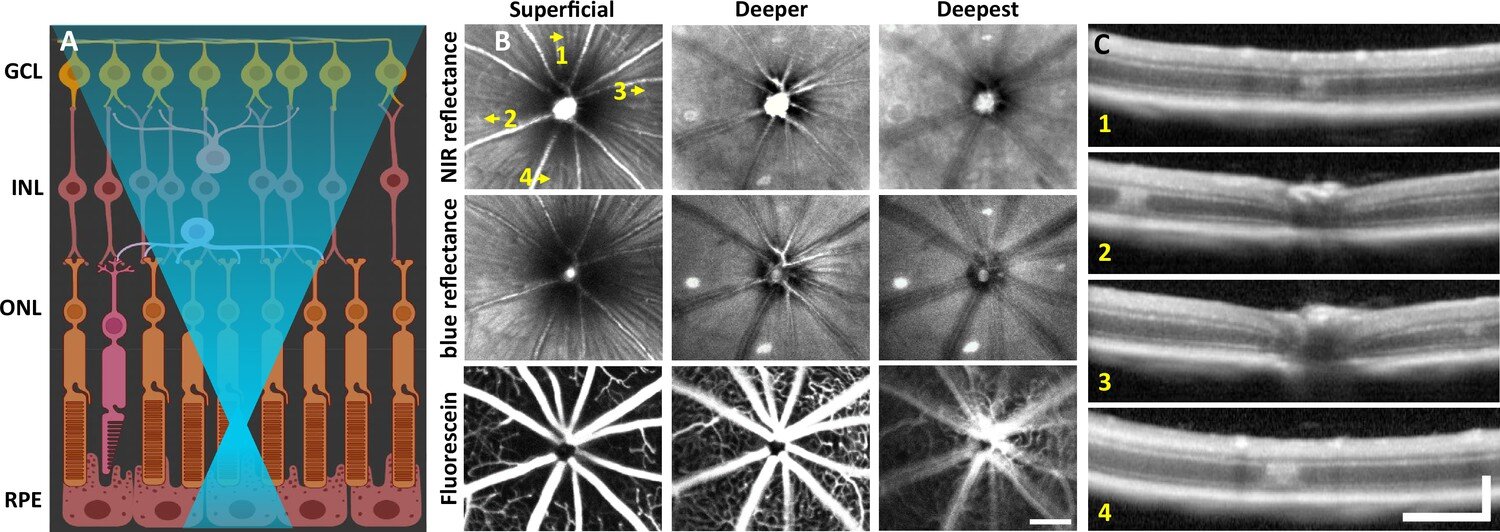

During most eye infections or injuries, neutrophils, immune cells found in the blood, are usually the first line of defense. However, researchers at the Flaum Eye Institute and Del Monte Institute for Neuroscience at the University of Rochester have discovered that the retina responds differently than many other tissues in the body. When photoreceptor cells in the retina are damaged, microglia, or the brain’s immune cells, respond, and the neutrophils are not recruited to help despite passing through nearby blood vessels.
“This finding has high implications for what happens to millions of Americans who suffer vision loss through loss of photoreceptors,” said Jesse Schallek, Ph.D., associate professor of Ophthalmology and senior author of a study appearing in eLife.
“This association between two key immune cell populations is essential knowledge as we build new therapies that must understand the nuance of immune cell interactions.”
Using adaptive optics imaging, a camera technology developed by the University of Rochester that allows the imaging of single neurons and immune cells inside the living eye, researchers studied the retinas of mice with photoreceptor damage. They found that while both neutrophil and microglia cells are present in the retina, only microglia cells respond to photoreceptor injury, and they do not call upon neutrophils to help repair the photoreceptor damage. Researchers believe this suggests a type of cloaking occurs during retinal injury to protect the retina from a rush of immune cells that could do more harm than good.
“What is remarkable here is that the passing neutrophils are so close to the reactive microglia, and yet they do not signal to them to assist in damage recovery,” said Schallek. “This is notably different than what is seen in other areas of the body where neutrophils are the first to respond to local damage and mount an early and robust response.”
Photoreceptor cells are unique to the retina. They process light into electrical and chemical signals and communicate that information to our brain, which allows us to see. There are many diseases that damage and kill photoreceptor cells, including age-related macular degeneration, retinitis pigmentosa, and cone-rod dystrophy, and currently, there is no cure. This research now shows it is possible to visualize the dynamics of single cells as they communicate with each other, as the retina responds to damage.
First author Derek Power, a laboratory technician in the Schallek lab, led the study. Other authors include Justin Elstrott, Ph.D., of Genentech Inc.
More information:
Derek Power et al, Photoreceptor loss does not recruit neutrophils despite strong microglial activation, eLife (2025). DOI: 10.7554/eLife.98662.4
Citation:
Study finds microglia—not neutrophils—handle photoreceptor damage in the retina (2025, July 24)
retrieved 29 July 2025
from https://medicalxpress.com/news/2025-07-microglia-neutrophils-photoreceptor-retina.html
This document is subject to copyright. Apart from any fair dealing for the purpose of private study or research, no
part may be reproduced without the written permission. The content is provided for information purposes only.
